Posted September 02, 2026

By Nick Riso
Who’s Afraid of the Big Bad VIX
The CBOE Volatility Index (VIX), as we know it, has been demoted.
This story begins in rural France with a Duke University finance professor named Robert Whaley.
He was spending the last four months of 1992 on sabbatical in Dijon with two PCs and a stack of hard drives that held every index option price the Chicago Board Options Exchange (now Cboe) had ever recorded. He must be a hoot at parties.
The exchange had commissioned him to build something that didn't exist yet… a number that could tell the market how much fear was priced into it.
Whaley worked the problem alone, in a rented office thousands of miles from any trading floor, running the same series of option prices through formula after formula until one of them held up.
After all that fun, he carried the finished methodology back to Chicago that winter. And on Jan. 19, 1993, the exchange unveiled it as the CBOE Volatility Index, built at first from S&P 100 options.
Then 10 years later, working with Goldman Sachs, Cboe rebuilt it around the S&P 500 using the wide-strike methodology that still defines it today.
Ever since, it's been known as Wall Street's "fear gauge" — a phrase that stuck so completely that most people who talk about it have no idea a professor with two PCs in rural France is the reason the number exists at all.
People have always used the VIX in a few different ways. “Vol trading” is quite complicated.
The simplest, though, are twofold.
They buy options on it, or the futures and ETPs built on top of it, when they think a shock is coming, treating it as portfolio insurance that pays out exactly when everything else is falling.
Or they sell it (or write premium against it) in the calmer stretches, treating that same insurance as a slow bleed of a check they get to cash.
And everyone, whether they trade it or not, watches it as a gut check on the market's mood.
But even though that’s true, I’d venture a guess that most don’t actually know what it is. They don’t understand that the VIX doesn't behave like most numbers you watch.
Volatility, and hence the VIX, is mean-reverting — Cboe's own description for it — meaning it doesn't drift upward over time the way stocks do.
It oscillates around a long-run average somewhere in the high teens to low twenties, and everything about how professionals actually use it depends on that fact. It’s only a little complicated.
A VIX at 14 is "calm” and sitting below its own gravity, and traders who watch VIX futures price higher than the spot level further out on the curve — a state called contango — read that as the market expecting a pull back toward that average.
When futures price lower than spot instead, in backwardation, that's the market pricing in near-term stress it doesn't expect to last.
It might sound exotic to us, but that’s the basic grammar every options desk uses to read the VIX's shape, not just its level.
Now, people have been measuring this as the fear gauge for over 30 years. But I'd contend a lot of people are watching the VIX simply because financial media is obsessed with it, not because it still does the job people think it does.
It's lost real relevance to modern markets.
May 11, 2022
This is the date almost nobody outside the options world knows, but it’s monumental.
Until that spring, S&P 500 index options only expired on Mondays, Wednesdays, and Fridays. A trader who wanted a contract that lived and died the same day had to wait for the right day of the week to show up.
Cboe started closing that gap on April 18, adding Tuesday expirations, and finished the job three weeks later.
On May 11, Thursday expirations went live, and for the first time since S&P 500 (SPX) options had existed, the index offered an expiration every single trading day of the week.
It sounds like plumbing. And it was. But it's the plumbing that made zero days to expiration (0DTE) trading possible five days a week instead of three.
And everything that follows — the new indices, the record volumes, the whole scramble to keep up — only had to happen because of what that one change let loose.
April 24, 2023
Three decades after Whaley's number first came into the world, Cboe rolled out a new index called VIX1D, built to measure expected volatility over the current trading day instead of the standard 30.
Same-day options on the S&P 500 had turned into the real market it is today. (See below.) 0DTE volume was about 5% of total SPX activity back in 2016, climbed to 22% once Cboe added Tuesday and Thursday expirations in 2022, and had passed 45% by the end of 2023. It kept climbing — 47% in 2024, 65% by this past May, a fresh record of 66.2% in July.
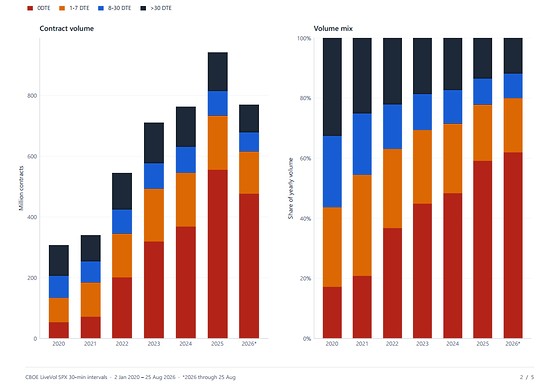
The majority of the market's actual options activity, the flow that drives dealer hedging and moves the tape intraday, now happens in contracts the VIX wasn’t ready for.
The index still samples options 23 to 37 days out, exactly as it has since 2003. By design, it's blind to the part of the market doing the most trading.
Cboe's own numbers, published the day VIX1D launched, made the gap almost embarrassing.
During the regional bank scare in March 2023, the VIX rose 39% over five trading days. Over that same stretch, the backtested VIX1D rose 163% — four times the move in the exact same market, over the exact same days.
Sept. 27, 2023
Five months after VIX1D, Cboe went looking for a second blind spot and found one in correlation.
A new index called DSPX launched. It was built to measure implied dispersion, or how much the S&P 500's constituents are expected to move relative to each other, as opposed to how much the index itself is expected to move.
Tim Edwards, who led index strategy at S&P Dow Jones Indices at the time, framed the goal as doing for dispersion what the VIX had done for volatility three decades earlier.
It was a strange thing to say about your own flagship product's new sibling, right? Why would a healthy volatility complex need something like that, unless the VIX alone couldn't provide it?
The reason DSPX needed to exist was actually mechanical (ugh).
Index-level volatility is a function of two things:
- How much individual stocks move
- How correlated those moves are with each other
When correlation falls — when two big names stop moving together and start trading on their own separate stories — the index can sit dead calm even while its components are anything but.
Dispersion trading has grown into an entire strategy built around harvesting exactly the gap between selling index volatility, buying single-stock volatility, and collecting the spread as long as correlation stays low.
The more popular that trade gets, the more it mechanically suppresses the VIX itself, whether or not the market underneath it is actually calm.
May 29, 2026
By this spring, the gap had become impossible to ignore.
Mandy Xu, Cboe's own head of derivatives market intelligence, told CNBC that what stood out that week was how calm the index looked even as single-stock volatility sat near a one-year high.
The spread between VIXEQ — Cboe's constituent-level volatility index, launched in late 2024 specifically to track this divergence — and the VIX itself was the widest it had been since January 2023.
In late June, Cboe measured dispersion at 42.5, near a one-year high, while one-month implied correlation had fallen to 9.5.
Earlier that same June, average single-stock volatility had run near 45% against a VIX sitting at 15.8 — a 29-point gap between what individual names were doing and what the index was telling you, the widest on record.
But always remember that a demotion is not an elimination. (Well…) None of this means the VIX has gone soft for good.
In March of this year, correlation did exactly what dispersion traders fear most – it snapped back, hard, after tensions over Iran escalated in the second week of the month.
The VIX spiked to 31.65 on March 27.
Stocks that had spent months trading on their own separate stories suddenly fell together, per usual, in a genuine macro shock, and the dispersion trade that had worked so well all year took a beating.
DSPX itself fell more than 6% that month, and a JPMorgan index tracking the strategy posted its worst month since 2011.
The VIX still knows how to bite my friend. It just spends most of its time now describing a market that's already moved on by the time anything actually happens.
By mid-August, the VIX had fallen back to an intraday low near 14 — more than 50% off its March high, in under five months — while dispersion and correlation went back to doing the real work underneath it, the way they'd been doing all along.
That's my argument here.
The big bad wolf has been demoted from the number that tells you what the market fears to one input among several, describing a 30-day, index-wide average in a market that increasingly trades same-day and stock-by-stock.
Cboe knows this! They've spent three years and four new indices proving it one launch at a time.
Sign Up Today for Free!
Truth & Trends brings you market insights and trading tips you won't find anywhere else — unless you have your own personal hedge fund manager on speed dial...
Meet Enrique Abeyta, one of Wall Street’s most successful hedge fund managers. With years of experience managing billions of dollars and navigating the highs and lows of the financial markets, Enrique delivers unparalleled market insights straight to your inbox.
In Truth & Trends, Enrique shares his personal take on what’s moving the markets, revealing strategies that made him a star in the world of high finance. Whether it’s uncovering the next big trend or breaking down the hottest stocks and sectors, Enrique’s insights are sharp, actionable, and proven to work in any market condition.
Inside these daily updates, you’ll gain:
- 50 years of combined trading wisdom distilled into actionable insights.
- A behind-the-scenes look at how Wall Street pros spot opportunities and avoid pitfalls.
- Exclusive strategies that Enrique personally uses to deliver exceptional returns — no fluff, just results.
To have Truth & Trends sent directly to your inbox every weekday, just enter your email address below to join this exclusive community of informed traders.
Don’t miss your chance to learn from one of the best in the business.
Sign up now and take your trading game to the next level.
The $2T Question for Anthropic
Posted August 31, 2026
By Enrique Abeyta
Breaking the Bitcoin Bear
Posted August 28, 2026
By Greg Guenthner

Argentina's Texas: The Energy Boom Nobody Expected
Posted August 27, 2026
By Enrique Abeyta

Whale Watching
Posted August 26, 2026
By Nick Riso

Countdown to the OpenAI-pocalypse
Posted August 24, 2026
By Enrique Abeyta