Posted September 03, 2026

By Enrique Abeyta
Welcome to Wall Street’s Most Dangerous Month
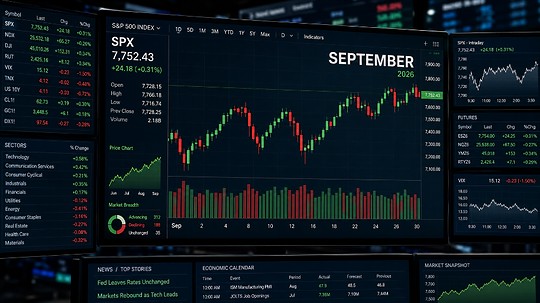
September has historically been the worst month of the year for stocks.
Since 1928, the S&P 500 has lost an average of about 1.1% during September, making it the worst month on the calendar.
And it gets even more interesting when you look at volatility.
The CBOE Volatility Index, better known as the VIX, measures market expectations for S&P 500 volatility over the next 30 days.
When investors become nervous, the VIX generally rises.
Since 1990, the VIX has gained an average of 8.2% in September, its strongest average month.
 Source: Benzinga
More strikingly, it has risen in each of the past five Septembers:
- 2021: +40.3%
- 2022: +22.2%
- 2023: +29.1%
- 2024: +12.0%
- 2025: +6.1%
If it rises again this month, that will mark the first six-year September winning streak since the VIX began in 1990.
But there’s an important catch.
Despite that 8.2% average September gain, the VIX has risen in only 18 of the past 36 Septembers. That’s exactly 50%.
In other words, blindly betting on higher September volatility has historically been about as reliable as a coin flip.
So how can the VIX average such a large September gain if it only rises half the time?
The Bad Septembers Are Really Bad
The answer is that September’s average is skewed by some enormous spikes in volatility.
During the financial crisis in September 2008, for example, the VIX soared more than 90%.
A handful of huge jumps like that pull the historical average higher.
So the historical signal isn’t that volatility always explodes in September.
It’s that when markets do become stressed, September has produced some unusually large volatility shocks.
Why?
Nobody knows for certain. But there are some logical explanations.
Think about what happens during summer.
People go on vacation, Wall Street trading desks thin out, and portfolio managers spend more time away from their screens.
A 2009 study published in the Journal of Financial Markets examined 51 stock markets and found that trading activity falls during summer vacation periods. Both large and small investors traded less.
Another study, published in Financial Management in 2017, examined school holidays across 47 countries. It found that stock returns during the month following major school holidays were 0.6% to 1% lower than during other months.
The researchers found that reduced investor attention during vacations may cause information to get reflected in stock prices more slowly.
Then September arrives.
Kids go back to school, adults go back to work, and portfolio managers return to their desks. And they’re returning with plenty of fresh information.
Second-quarter earnings season is almost over, and investors have a new set of earnings, guidance, and management forecasts to consider.
Meanwhile, the third quarter is nearing its end, giving funds another reason to reassess and rebalance their portfolios.
None of this proves why September is volatile.
But it does create an interesting setup: A lot of investors return at the same time, armed with fresh information and reasons to move money around.
More trading isn’t bearish, of course. Investors can just as easily come back from vacation and buy.
However, if all that fresh activity happens when the market is stressed, we can see some large moves.
What About This September?
Wall Street isn’t returning to an empty calendar.
The Federal Reserve meets starting on Sept. 15 with interest rates, inflation, and the economy once again front and center.
Any surprises in the Fed's decision, projections, or comments could quickly move stocks, bonds, and volatility.
The Fed isn’t the only unknown.
The November midterm elections are now just two months away, with control of Congress potentially up for grabs.
Markets don’t like uncertainty, and the election gives investors another major variable to consider.
Add an already complex situation for inflation, interest rates, oil, and global politics, and Wall Street has plenty to think about.
None of that means stocks are headed lower. In fact, there are even reasons to feel good.
The S&P 500 started September well above its 200-day moving average.
This setup has often produced much better September returns than when the market enters the month below that key metric.
So I’m not predicting a selloff, and I’m not saying the VIX will rise for a sixth September in a row. But I certainly want to follow it closely.
September has historically been Wall Street's worst month. When volatility does hit, the moves can be unusually large.
And this year, we have several events that could put that history to the test.
Sign Up Today for Free!
Truth & Trends brings you market insights and trading tips you won't find anywhere else — unless you have your own personal hedge fund manager on speed dial...
Meet Enrique Abeyta, one of Wall Street’s most successful hedge fund managers. With years of experience managing billions of dollars and navigating the highs and lows of the financial markets, Enrique delivers unparalleled market insights straight to your inbox.
In Truth & Trends, Enrique shares his personal take on what’s moving the markets, revealing strategies that made him a star in the world of high finance. Whether it’s uncovering the next big trend or breaking down the hottest stocks and sectors, Enrique’s insights are sharp, actionable, and proven to work in any market condition.
Inside these daily updates, you’ll gain:
- 50 years of combined trading wisdom distilled into actionable insights.
- A behind-the-scenes look at how Wall Street pros spot opportunities and avoid pitfalls.
- Exclusive strategies that Enrique personally uses to deliver exceptional returns — no fluff, just results.
To have Truth & Trends sent directly to your inbox every weekday, just enter your email address below to join this exclusive community of informed traders.
Don’t miss your chance to learn from one of the best in the business.
Sign up now and take your trading game to the next level.
Who’s Afraid of the Big Bad VIX
Posted September 02, 2026
By Nick Riso
The $2T Question for Anthropic
Posted August 31, 2026
By Enrique Abeyta
Breaking the Bitcoin Bear
Posted August 28, 2026
By Greg Guenthner

Argentina's Texas: The Energy Boom Nobody Expected
Posted August 27, 2026
By Enrique Abeyta

Whale Watching
Posted August 26, 2026
By Nick Riso