Posted November 11, 2026

By Zach Scheidt
Wall Street’s "Fear Gauge" Just Gave You a Raise
Last week, I promised to show you my “touch-and-go” strategy for option trading. And that's still coming.
But the weather has changed since then. And any good pilot knows when it’s time to change the flight plan.
So I’m going to adjust course and talk about something else today — the volatility that’s hitting the market right now.
The Nasdaq 100 has lost about $5.6 trillion in value since its early October peak. Chip stocks just had their sixth straight losing week.
And the CBOE Volatility Index (VIX), commonly referred to as Wall Street's "fear gauge," spiked 70% last Thursday.
The index closed near 25 on Friday, its highest level since early April.
Most investors see statistics like these and start to feel nervous. But you can think of market volatility like turbulence on a flight.
While it may not be a pleasant experience, it doesn’t mean that anything is wrong. It’s completely normal.
 The view out of my cockpit on a turbulent flight last week.
And for income investors, this kind of market “turbulence” can actually be a gift.
Because one of my favorite options trading strategies, something I’ve been doing for years, is more profitable than usual during these periods of volatility.
Allow me to explain…
Getting Paid to Buy a Stock You Already Want
Think of the VIX as the price of insurance for the stock market. It measures how much investors have to pay for protection from a bear market.
When investors feel calm, nobody wants much protection. Insurance is cheap.
When investors get scared, everyone wants protection at once. So insurance gets expensive. And in the options market, the "insurance policy" is a put option.
As a quick refresher, a put gives its owner the right to sell a stock at a set price (the strike price) before a certain date (the expiration date).
Nervous investors buy puts to protect themselves from falling prices. But somebody has to sell them that protection.
That somebody can be you!
When you sell a put, you collect cash up front. Today.
In exchange, you agree to buy a stock at a lower price if it falls below the strike price by a certain date.
If the stock stays above that price, the put expires. You keep the cash, and your obligation goes away.
If the stock falls below that price, you buy shares at the discount you picked ahead of time. And you still keep the cash you collected.
Selling put contracts on a variety of different stocks, over and over again, is my favorite strategy for generating reliable income from the stock market.
Now here’s an important foundation for this strategy: I only sell puts on stocks I'd be happy to own.
When I sell a put, I get paid. That part is automatic.
The only question is whether I also end up owning a great company at a lower price.
Here's what makes right now so interesting…
When the VIX climbs, put prices climb with it. So put sellers collect more income for the same promise.
Or better yet, we can make a safer promise and still collect more income. Here’s a real example from earlier this week…
On Monday, I sold a put on Hewlett Packard Enterprise (HPE) in my Income Alliance portfolio.
(I won't share the specifics. That's for subscribers, who get my trade alerts in real time. But the concept is what matters.)
HPE builds the networking gear, servers, and storage that big businesses run on, including servers built for AI.
Over the past six weeks, the stock has slid along with the rest of tech. Investors are nervous about AI hardware and tech stocks in general.
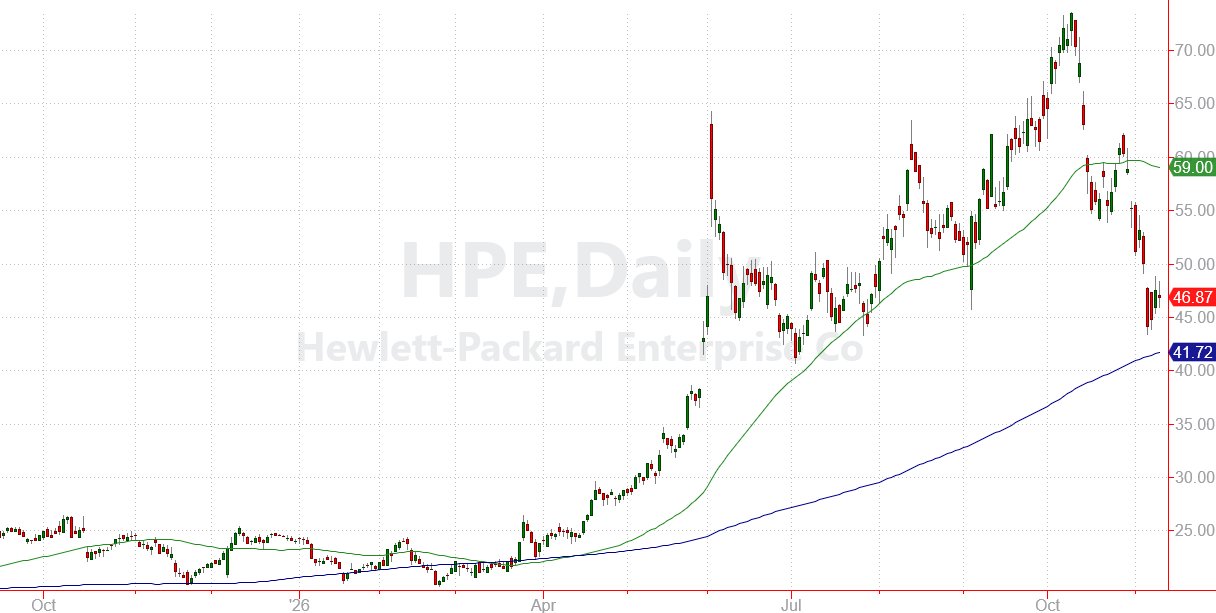
But I don't see a broken business. I see a good company caught in a sour mood.
The stock trades for about 10 times what analysts expect it to earn. And it just pulled back to its 200-day moving average, a key support level (blue line in the chart above).
So I agreed to buy HPE about 9% below where it trades today.
And because the market is nervous, I collected 7% of the cash I set aside for a trade that lasts about five weeks. In calmer markets, a setup like this might pay closer to 3% or 4%.
Think about that. A cheaper stock. A bigger cushion below today's price. And more income for my trouble.
That combination doesn't show up every day. Turbulence is what makes it possible.
The Gust Factor
As a pilot, I see a lot of overlap between flying and trading.
On a gusty day, pilots use something called the "gust factor."
Let's say the wind is blowing 15 knots, gusting to 25. The gust factor is the difference (10 knots, in this example).
When you come in to land on a day like that, you add half the gust factor to your approach speed. So you'd fly the approach 5 knots faster than normal.
Why? Because rough air can suddenly rob you of airspeed. That extra speed is your margin of safety.
The rougher the air, the more margin you build in.
Selling puts in a volatile market works the same way.
When the market gets bumpy, I build in extra margin by choosing a strike price further below the stock price.
And here's the part I get excited about…
In the options market, the rough air pays you more for flying with that extra margin.
Option prices are higher right now for a reason. The risk is real.
A stock can fall further than you expect. If it drops well below your strike price, you'll still have to buy shares at the price you agreed to, and the stock could keep falling from there.
So I follow a few simple rules:
- Only sell puts on stocks you'd be glad to own at that price.
- Always set aside the cash to buy the shares. Each contract covers 100 shares.
- Know your exit plan before you place the trade.
Pilots brief for emergency situations before takeoff. Traders should too.
Why Now Is a Good Time
Spikes in the VIX don't last forever.
According to research from The Daily Shot, higher VIX readings have historically come before above-average returns for the S&P 500.
And Bespoke Investment Group points out that last week's selloff pushed the Nasdaq 100 deeper below its 50-day moving average than at any point in this bull market.
Moves that extreme have usually been followed by strong returns.
That doesn't mean the bumps are over. But it does mean today's fear is creating an opportunity.
When the air smooths out, option prices will come back down. Put sellers will collect less income for the same promise.
Right now, the market is paying a premium for patience. I plan to collect it.
Next week, I'll get back to that touch-and-go strategy, or how to butter the landing on a winning trade and climb right back out.
In the meantime, I'd love to hear from you.
What's one stock you'd love to own, if you could buy it at a discount? Just send me an email, and I may feature it in an upcoming issue.
Sign Up Today for Free!
Truth & Trends brings you market insights and trading tips you won't find anywhere else — unless you have your own personal hedge fund manager on speed dial...
Meet Enrique Abeyta, one of Wall Street’s most successful hedge fund managers. With years of experience managing billions of dollars and navigating the highs and lows of the financial markets, Enrique delivers unparalleled market insights straight to your inbox.
In Truth & Trends, Enrique shares his personal take on what’s moving the markets, revealing strategies that made him a star in the world of high finance. Whether it’s uncovering the next big trend or breaking down the hottest stocks and sectors, Enrique’s insights are sharp, actionable, and proven to work in any market condition.
Inside these daily updates, you’ll gain:
- 50 years of combined trading wisdom distilled into actionable insights.
- A behind-the-scenes look at how Wall Street pros spot opportunities and avoid pitfalls.
- Exclusive strategies that Enrique personally uses to deliver exceptional returns — no fluff, just results.
To have Truth & Trends sent directly to your inbox every weekday, just enter your email address below to join this exclusive community of informed traders.
Don’t miss your chance to learn from one of the best in the business.
Sign up now and take your trading game to the next level.
A Reckoning for the Riskiest AI Trades
Posted November 10, 2026
By JC Parets

November 5: The Day the AI-pocalypse Began
Posted November 09, 2026
By Enrique Abeyta

Big Tech Wants Inside Your Head
Posted November 06, 2026
By Greg Guenthner

OpenAI Is the Next Bear Stearns
Posted November 05, 2026
By Enrique Abeyta
IBM: The "Lose-Lose" AI Trade
Posted November 04, 2026
By Zach Scheidt
