
Posted May 18, 2026

By Enrique Abeyta
Trump Meets Xi for “Crisis Summit” 2026
Trump's trip to Beijing last week was the first visit by a sitting U.S. president to China in nearly a decade.
The agenda was stacked. Tariffs, AI, Taiwan, semiconductors, and the Strait of Hormuz.
It was a high-stakes meeting between two of the world’s most important leaders, and investors were watching closely.
And then... it was over. No sudden breakthroughs or major announcements.
On the surface, it seemed almost anticlimactic. But here's what the headlines missed.
Beneath the carefully staged photo opportunities and diplomatic pleasantries, something more significant was taking shape…
What increasingly looks like an emergency stabilization meeting for the global economy itself.
After months of markets whipsawed by inflation fears, oil price spikes, and Middle East tensions, even a quiet step toward cooperation between the U.S. and China carries enormous weight.
If the two countries continue to cooperate, this summit could become one of the most important turning points of the year.
The Market’s Biggest Fear May Be Fading
Going into the summit, most investors expected the meetings to focus on trade tensions and tariffs. After all, that has largely defined the U.S.-China relationship for years now.
But by the end of the week, it became increasingly clear that the real urgency centered around energy stability and Iran.
That’s because both the U.S. and China suddenly share the same massive problem: neither can afford a prolonged disruption in the Strait of Hormuz.
China imports enormous amounts of oil through the region.
Meanwhile, the U.S. desperately wants to avoid another energy shock that could drive prices higher, destabilize financial markets, and force the Fed to keep interest rates higher for longer.
In other words, both superpowers suddenly have aligned incentives. That’s an incredibly important shift.
For the past several years, the relationship between the U.S. and China has increasingly been viewed through a Cold War lens.
Investors have become accustomed to hearing about decoupling, sanctions, export restrictions, AI chip bans, and growing geopolitical rivalry.
But this summit suggested something different.
When global economic stability itself is threatened, both countries still need each other more than many investors want to admit.
And the market is noticing.
For months, investors have been trapped in a nonstop cycle of uncertainty.
Would oil prices explode higher? Would the Strait of Hormuz remain disrupted? Would U.S.-China relations continue deteriorating?
Markets hate uncertainty more than almost anything else. And for much of this year, uncertainty has dominated the narrative.
That’s why this summit may matter so much.
One of the biggest developments came when reports surfaced that Trump discussed easing pressure on certain Chinese firms that purchase Iranian oil.
That’s an incredibly important signal.
Just days earlier, the administration had been aggressively sanctioning entities tied to Iranian oil shipments.
Suddenly, the tone shifted dramatically. Instead of escalation, investors began hearing words like “stability,” “cooperation,” and “normalization.”
Now, to be clear, none of this means geopolitical risks have disappeared. Far from it.
But markets do not require perfection to rally. They simply require conditions to become “less bad” than investors previously feared.
And that may be exactly what’s happening now.
Why Stocks Could Love This Outcome
If this summit ultimately helps stabilize energy markets and shipping routes, investors could suddenly begin pricing in a much more optimistic economic backdrop.
Think about the chain reaction that could follow.
Lower oil prices would help reduce inflation pressure. Reduced inflation pressure would ease fears surrounding interest rates.
More stable shipping lanes would improve global supply chains. Better supply chains would support corporate margins. Improved margins would strengthen earnings growth.
And earnings growth is what ultimately drives stock prices higher over the long run.
In many ways, investors may have spent the past several months positioning for worst-case scenarios that now look less likely than they did before this summit began.
That’s important because when positioning becomes overly defensive, even modest stabilization can become extremely bullish for markets.
This is especially true in the current environment, where investors remain heavily focused on growth sectors tied to AI and infrastructure spending.
One of the biggest takeaways from this summit is that AI is no longer just a software story.
The AI boom depends on one of the most complex industrial ecosystems ever created.
It requires semiconductors, networking equipment, data centers, cooling systems, power generation, electrical infrastructure, shipping networks, and highly specialized manufacturing spread across multiple continents.
The U.S. dominates some parts of that ecosystem. China dominates or heavily influences others.
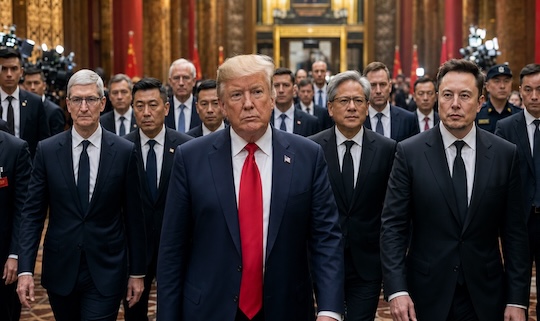
That’s why the presence of so many major U.S. CEOs in Beijing mattered so much.
Executives from Apple, Nvidia, Tesla, Boeing, BlackRock, Visa, Mastercard, Micron, Qualcomm, and many others were all connected to summit-related meetings in some capacity.
As mentioned last week, collectively, the companies represented account for roughly $16 trillion to $18 trillion in market value. That’s approximately one quarter of the entire U.S. stock market.
That concentration of corporate power tells investors something extremely important.
This was never just about politics.
It was about protecting the economic foundation underneath the global AI buildout.
Despite years of headlines about "decoupling," the modern global economy remains deeply interconnected.
And nowhere is that more obvious than in AI infrastructure.
If investors continue to gain confidence that inflation pressures are easing while AI investment remains intact, many of the market leaders we've already seen could continue to outperform.
Semiconductors could benefit. AI infrastructure companies could benefit. Cybersecurity stocks could benefit. Industrial electrification and power infrastructure companies could benefit.
Transportation and logistics companies could also rally as investors gain confidence that global shipping routes will remain stable.
Importantly, lower energy volatility could also help improve consumer confidence and spending, creating a healthier overall backdrop for the broader market.
That combination creates the exact type of environment where growth stocks tend to perform very well.
Especially after many investors spent much of the year positioned defensively around inflation and geopolitical risk.
Back to the Big Picture
One of the most important lessons from this summit is that economic reality often overrides political rhetoric.
For years, headlines have focused on the division between the U.S. and China. And those tensions are very real.
But this summit also reminded investors that the world's two largest economies remain deeply intertwined in ways that cannot be easily unwound overnight.
The AI boom depends on it. Global manufacturing depends on it. Energy stability depends on it. Financial markets depend on it.
That does not mean tensions suddenly disappear from here.
But it does suggest that both sides recognize the dangers of allowing the global economy to spiral into deeper instability at the exact moment AI is triggering one of the largest infrastructure buildouts in modern history.
And if this summit marked the beginning of even modest stabilization, investors may ultimately look back on this meeting as one of the most important market turning points of 2026.
Sign Up Today for Free!
Truth & Trends brings you market insights and trading tips you won't find anywhere else — unless you have your own personal hedge fund manager on speed dial...
Meet Enrique Abeyta, one of Wall Street’s most successful hedge fund managers. With years of experience managing billions of dollars and navigating the highs and lows of the financial markets, Enrique delivers unparalleled market insights straight to your inbox.
In Truth & Trends, Enrique shares his personal take on what’s moving the markets, revealing strategies that made him a star in the world of high finance. Whether it’s uncovering the next big trend or breaking down the hottest stocks and sectors, Enrique’s insights are sharp, actionable, and proven to work in any market condition.
Inside these daily updates, you’ll gain:
- 50 years of combined trading wisdom distilled into actionable insights.
- A behind-the-scenes look at how Wall Street pros spot opportunities and avoid pitfalls.
- Exclusive strategies that Enrique personally uses to deliver exceptional returns — no fluff, just results.
To have Truth & Trends sent directly to your inbox every weekday, just enter your email address below to join this exclusive community of informed traders.
Don’t miss your chance to learn from one of the best in the business.
Sign up now and take your trading game to the next level.

3 Tickers to Watch as the Semi Trade Unwinds
Posted May 15, 2026
By Greg Guenthner
The $16 Trillion China Summit
Posted May 14, 2026
By Enrique Abeyta

The Tell-Tape Heart
Posted May 13, 2026
By Nick Riso

All-Time Highs... in THIS Economy?
Posted May 11, 2026
By Enrique Abeyta

The "Killer Bees" Are Swarming Again
Posted May 08, 2026
By Greg Guenthner
