Posted November 02, 2026

By Enrique Abeyta
The Election Is Coming! Sell Everything! (Just Kidding)
The blue wave is coming!
Wall Street is bracing for impact!
Sell your stocks! Buy gold! Head for the hills!
Midterm elections are tomorrow, and the political hype machine is running at full speed.
Everywhere you turn, someone is warning about what might happen if the wrong party wins.
But before you make any investment decisions, you should know something…
The stock market doesn't care nearly as much about who wins elections as some headlines would make you think.
I know that sounds crazy in today's political climate. But I've got decades of experience and market data to back it up.
And what those numbers reveal might surprise you.
The Market Doesn’t Have a Favorite Party
Politicians would have you believe that your financial future depends on their victory.
And the media has every reason to keep you watching, clicking, and worrying until the last vote is counted.
But the stock market has spent decades ignoring much of that political drama.
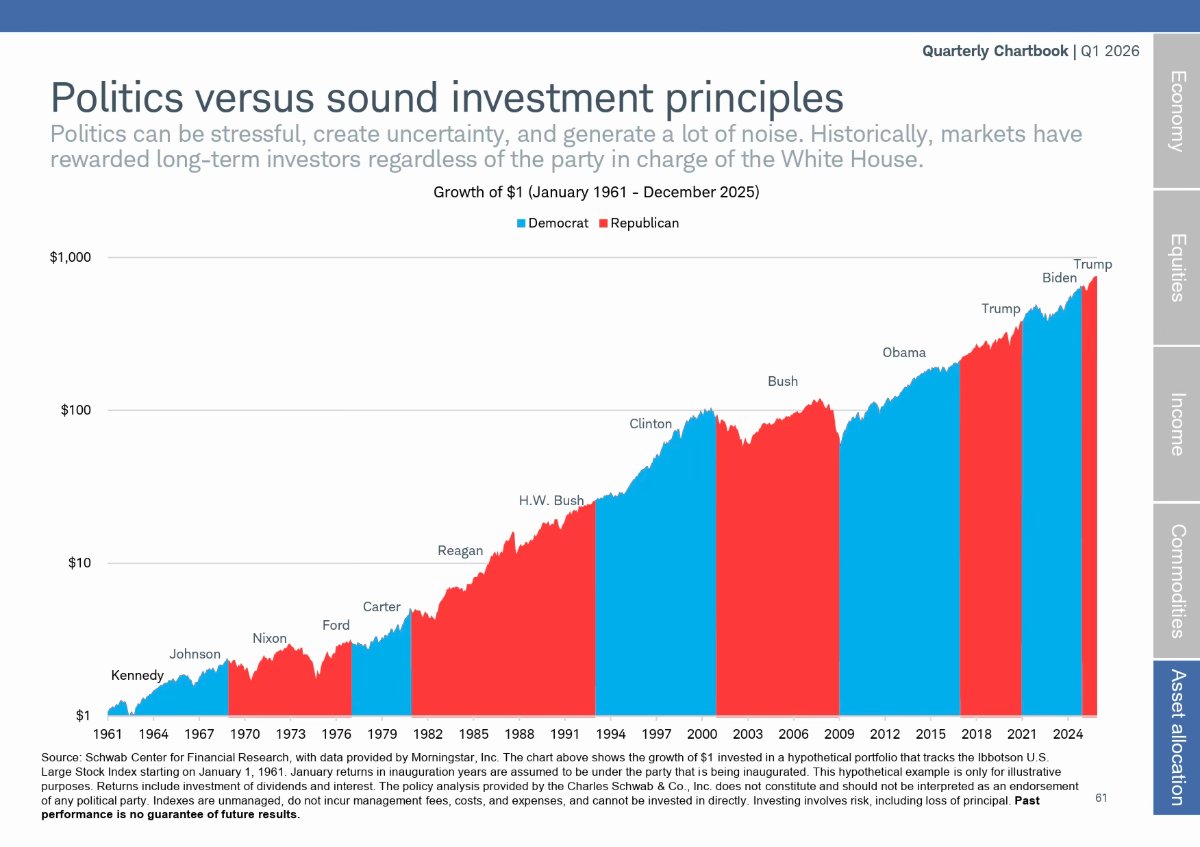
Consider this chart from Charles Schwab. It shows what $1 invested in a broad basket of U.S. stocks did between 1961 and 2025.
Growth Of $1 Invested In Stocks, 1961–2025
 Source: Schwab Quarterly Chartbook, Q1 2026, Data provided by Morningstar.
In that time, that dollar grew to roughly $750.
Along the way, America elected presidents from both parties and saw Congress change hands many times.
We lived through the soaring inflation of the 1970s, the 1987 market crash, the dot-com bust, the 2008 financial crisis, and the COVID pandemic.
Through it all, stocks kept climbing over the long run.
And notice something else.
Some of the biggest market crashes took place under Republican presidents, while others happened under Democrats.
The same is true of major rallies.
That's because stock prices depend on far more than whoever happens to occupy the White House.
Company profits, interest rates, inflation, new technology, and the health of the economy all play huge roles.
And those forces don't suddenly reset every time Americans head to the polls.
Of course, presidents don't govern alone. Congress controls spending and helps shape the laws that affect businesses and investors.
So, what happens when we look at the different ways power can be split in Washington?
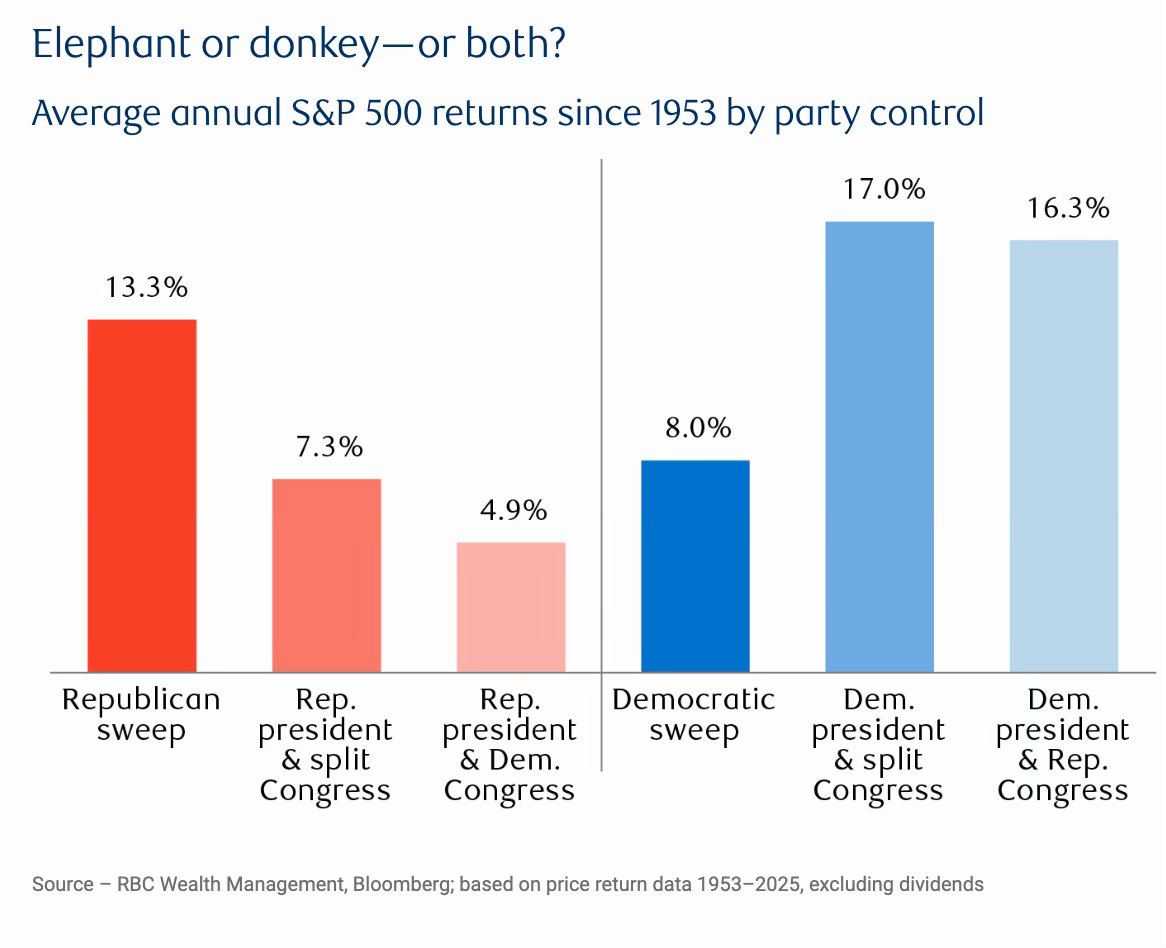
RBC Capital Markets studied average annual S&P 500 returns under six forms of party control from 1953 through 2025.
Here's what it found.
How Stocks Have Performed Under Six Scenarios
 Source: RBC Capital Markets
Notice anything interesting? Stocks posted positive average annual returns under all six setups.
A Republican president with Republican control of Congress? Positive returns.
A Democratic president with a split Congress? Positive returns.
A Republican president facing a Democratic Congress? Positive returns.
In fact, the chart shows average yearly gains ranging from roughly 5% to 17%, based on who held power.
Now, that doesn't mean all six outcomes are equally good for stocks. And past averages can't tell us what will happen after any one election.
But they do expose a major flaw in the idea that one party winning must spell disaster for your portfolio.
Neither party has a monopoly on stock market gains.
That doesn’t mean the market is completely indifferent to elections, though. History shows the months following midterms have been quite good for stocks.
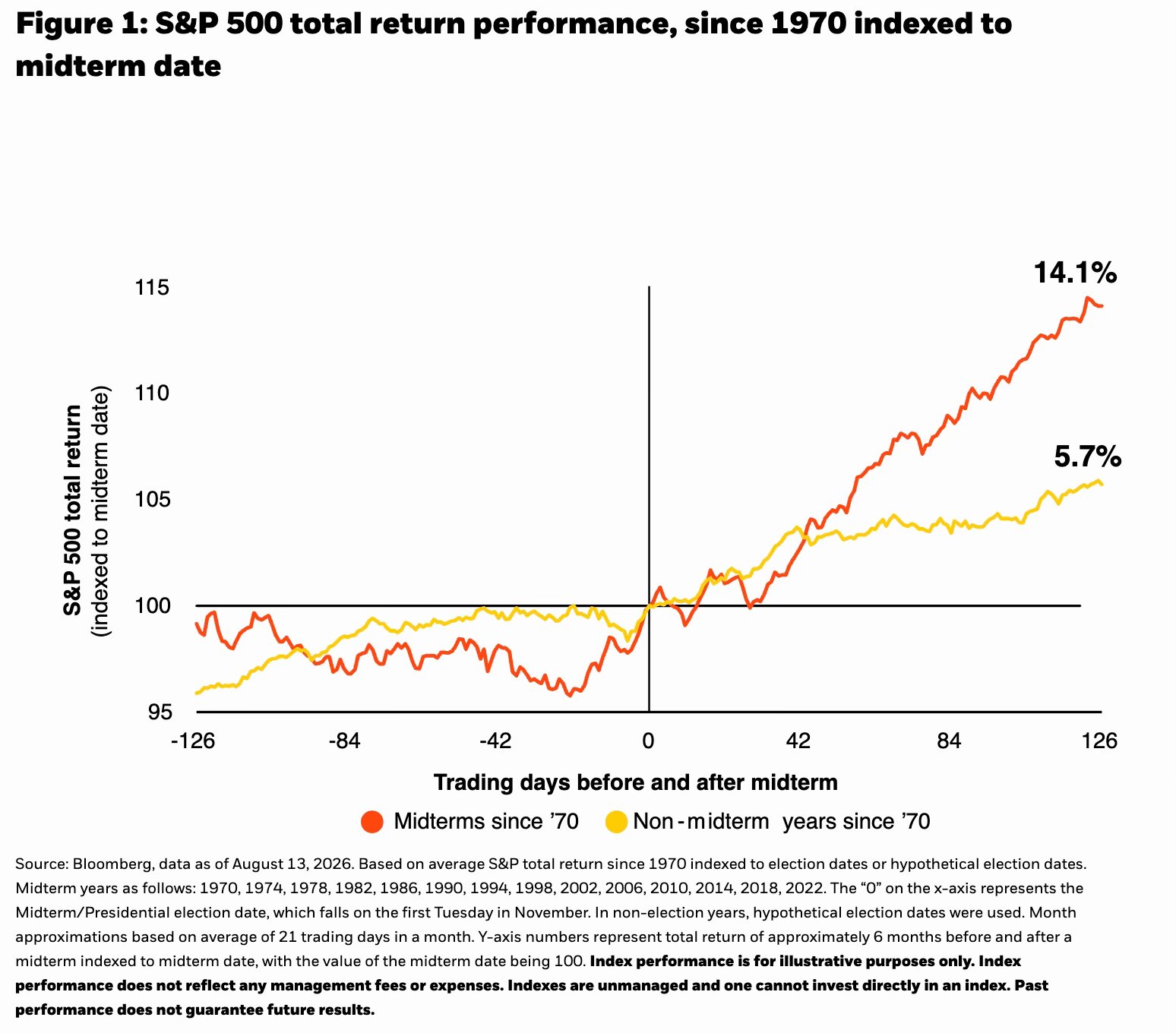
BlackRock studied S&P 500 returns around midterm elections dating back to 1970. Take a look.
Average S&P 500 Returns Surrounding Midterm Elections
 Source: BlackRock
Stocks have often struggled in the months leading up to midterms, then bounced back as Election Day draws near.
And the gains that followed have been striking.
According to BlackRock, the S&P 500 gained an average of 14.1% in the six months after midterms, compared with 5.7% during similar periods in non-midterm years.
That's nearly 2.5 times the average return.
Why? One possible reason is that markets hate uncertainty.
Once an election is over, investors have a clearer sense of what lies ahead. They can refocus on the economy.
Of course, other forces are at work, including the business cycle and Federal Reserve policy.
We can't give elections all the credit for those gains.
Still, the historical record hardly supports the idea that midterms are a reason to flee the stock market.
Quite the opposite.
The Cost of Voting With Your Portfolio
Imagine selling your stocks every time the party you disliked took control of Washington. You'd have missed some huge rallies.
BlackRock found that investors who moved to cash whenever their preferred party was out of power would have earned roughly half the returns of those who stayed invested.
Think about that.
All that political fear, all those dire warnings, and all those efforts to protect your money from the other party could have cost you a fortune.
And this isn't a problem limited to one side.
Republicans have watched stocks rally under Democratic presidents.
Democrats have watched stocks climb under Republican presidents.
That's why I believe as investors, we need to keep our political views separate from our investment choices.
You can care deeply about an election without letting its outcome dictate what you do with your money.
Before I go, I want to leave you with one warning.
The charts we've examined cover decades when American politics was often less divided than it is today.
Politicians more often accepted election results. Members of both parties could work together. And the news wasn't driven by today's endless fight for clicks and outrage.
The government also played a smaller role in our economy.
In 1960, total government spending was about 27% of GDP. Today, it's closer to 38%. In countries like France, that figure tops 50%.
That doesn't mean bigger government leads to worse stock returns.
But as Washington spends more and takes a larger role in trade and business rules, its decisions may have more power to move markets.
And if America's political divide keeps growing, the past may become a less useful guide to how stocks react to elections.
I certainly hope that doesn't happen.
In my opinion, one of America's greatest strengths has been its ability to let private firms grow, compete, and create wealth no matter which party runs Washington.
That's a tradition worth keeping.
So, by all means, take tomorrow’s election seriously. Vote for the candidates you believe will best serve the country.
But don't confuse your political views with an investment plan.
Today's stock market faces real risks, including the vast sums being poured into artificial intelligence.
I've spent plenty of time warning you about them.
Those risks deserve your attention. Election hysteria doesn't.
Because when it comes to building wealth, what happens on Wall Street over the next several years matters far more than who celebrates victory Tuesday night.
Sign Up Today for Free!
Truth & Trends brings you market insights and trading tips you won't find anywhere else — unless you have your own personal hedge fund manager on speed dial...
Meet Enrique Abeyta, one of Wall Street’s most successful hedge fund managers. With years of experience managing billions of dollars and navigating the highs and lows of the financial markets, Enrique delivers unparalleled market insights straight to your inbox.
In Truth & Trends, Enrique shares his personal take on what’s moving the markets, revealing strategies that made him a star in the world of high finance. Whether it’s uncovering the next big trend or breaking down the hottest stocks and sectors, Enrique’s insights are sharp, actionable, and proven to work in any market condition.
Inside these daily updates, you’ll gain:
- 50 years of combined trading wisdom distilled into actionable insights.
- A behind-the-scenes look at how Wall Street pros spot opportunities and avoid pitfalls.
- Exclusive strategies that Enrique personally uses to deliver exceptional returns — no fluff, just results.
To have Truth & Trends sent directly to your inbox every weekday, just enter your email address below to join this exclusive community of informed traders.
Don’t miss your chance to learn from one of the best in the business.
Sign up now and take your trading game to the next level.
You Gotta Be Quicker Than That!
Posted October 30, 2026
By Greg Guenthner
NVIDIA: The Biggest Stock Massacre in History
Posted October 29, 2026
By Enrique Abeyta
5 Ways to Play Amazon's Earnings (I Made My Bet)
Posted October 28, 2026
By Zach Scheidt

The Calendar Turns Bullish
Posted October 27, 2026
By JC Parets

6 Stages of a Credit Bubble: From Mania to Meltdown
Posted October 26, 2026
By Enrique Abeyta