Posted November 12, 2026

By Enrique Abeyta
The Cruel Irony of the Dot-Com Crash
It’s the fall of 1999. You're sitting at your desk, surfing the Web on your colorful new Apple iMac G3.
Netscape Navigator is open, and you're catching up on the latest news.
The No. 1 hit "Smooth" by Santana and Rob Thomas, which you just downloaded for free on Napster, plays in the background.
Life is good, and the future looks even better.
The internet is changing everything.
New companies are popping up almost daily, and their stocks seem to have nowhere to go but up.
Everyone wants a piece of the action.
What could possibly go wrong?
Plenty, as it turns out.
The Nasdaq would lose nearly 78% of its value within three years, wiping out fortunes and leaving countless investors wondering what happened.
Yet the internet would go on to transform nearly every part of our lives.
In recent issues, we've explored how technology and credit bubbles form, and why today's AI boom is showing some troubling signs.
Today, we're going back to the original internet bubble to see how it began, how it ended, and what it can teach us about protecting our money from another devastating tech crash.
The Internet Revolution: When Excitement Became Mania
In the early 1990s, the World Wide Web was still new to most Americans.
Getting online often meant using a slow dial-up connection, and few people had ever bought anything over the internet.
Then came Netscape.
Its Navigator browser made the Web easier to use. And when Netscape went public in August 1995, Wall Street went wild.
Shares priced at $28 closed their first day of trading at $58.25, more than doubling in a matter of hours.
Investors had good reason to be excited.
The internet promised to change how people shopped, worked, communicated, and found information. Businesses could reach customers across the country without opening a single store.
Venture capital poured into internet startups, while Wall Street rushed to take them public, giving young businesses access to vast sums of money.
The trouble was that many had yet to prove they could earn a profit.
That didn't seem to matter.
By 1999, the internet boom had become a full-blown stock market frenzy.
Investors were buying shares in companies with little revenue, no profits, and sometimes barely a working business.
Instead of asking how much money a company earned, Wall Street focused on website visitors, customer growth, and the size of the market it hoped to capture.
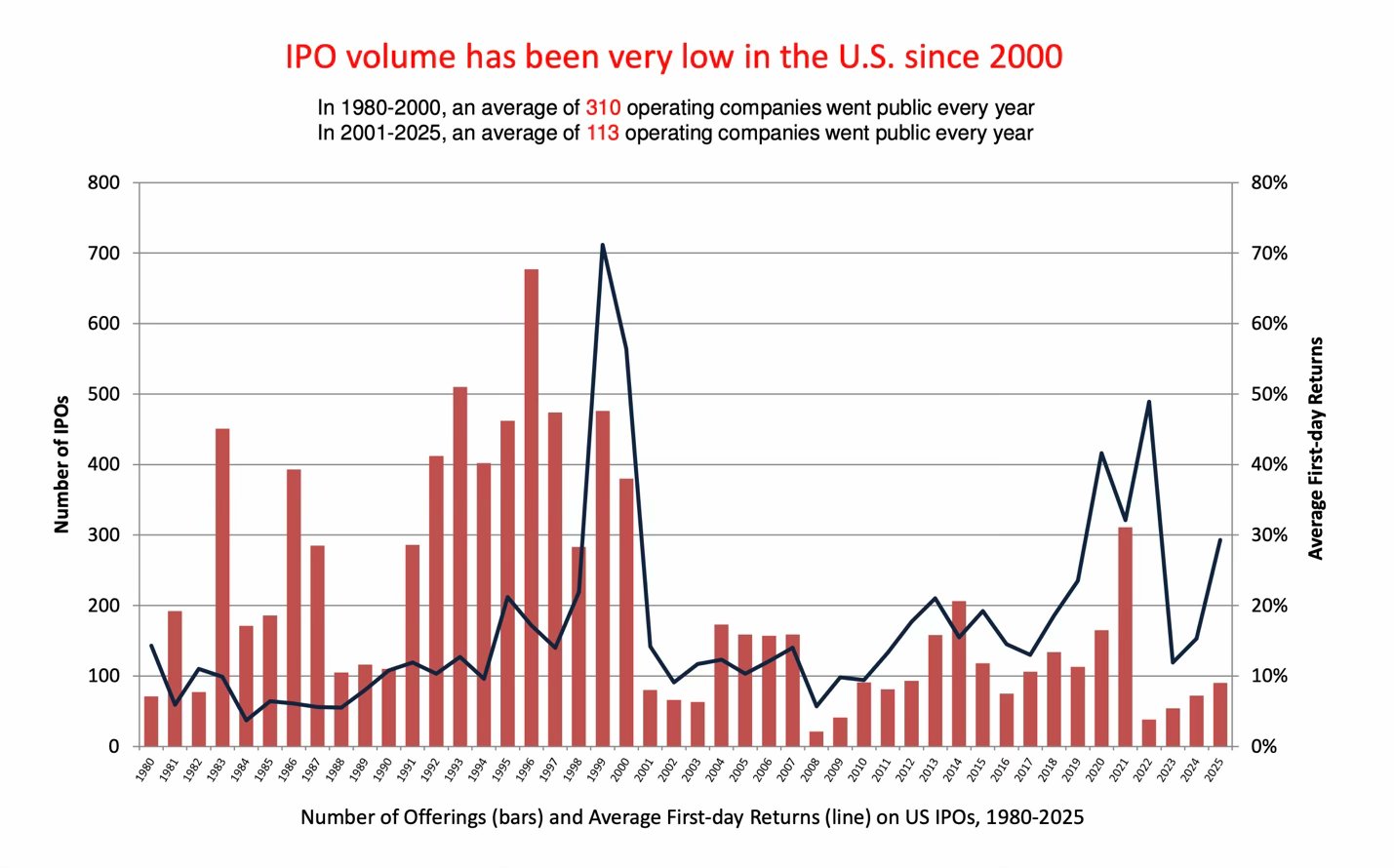
And the IPO market was on fire.
According to historical data compiled by finance professor Jay Ritter, 446 companies went public in 1999 under his study's criteria.
Their shares gained an average of nearly 71% on their first day of trading.
One company, VA Linux, surged almost 700% in a single day.
U.S. IPO Activity, 1980–2025
 Source: Jay R. Ritter, University of Florida, Initial Public Offerings: Updated Statistics.
But the frenzy wasn't limited to internet startups.
Telecom companies borrowed billions to lay fiber-optic cables, build networks, and buy equipment to handle an expected explosion in internet traffic.
Many built competing networks along the same routes, convinced that demand would keep growing fast enough to make them profitable.
Internet traffic did grow.
But as more capacity came online, prices fell. Some carriers were left with heavy debts and far less revenue than expected.
By early 2000, the boom rested on two dangerous assumptions: investors would keep funding unprofitable startups, and telecom customers would eventually pay enough to justify the construction spree.
Both were about to be tested.
The Bubble Finally Bursts
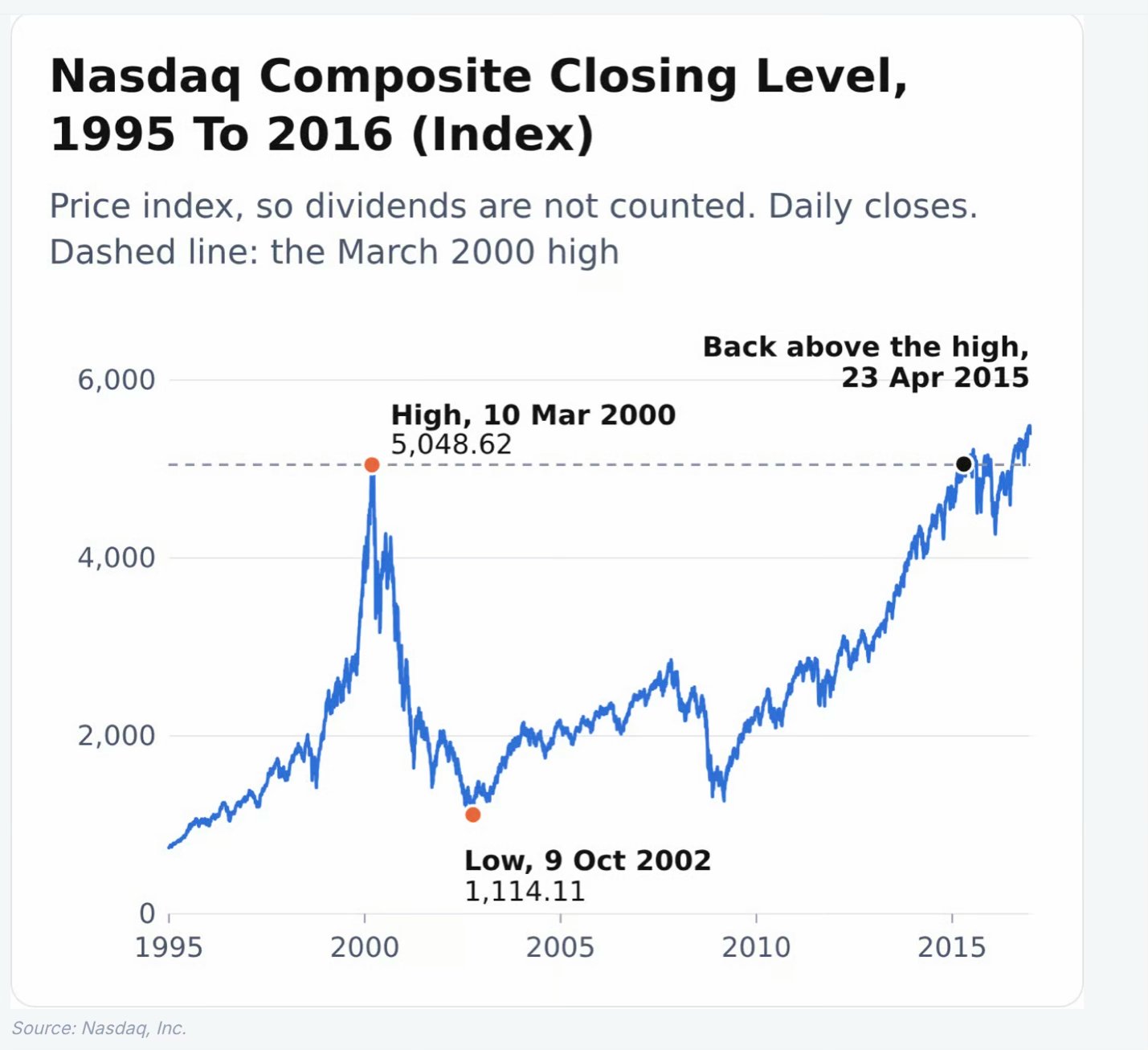
On March 10, 2000, the Nasdaq Composite closed at a record 5,048.62.
It had gained roughly 86% in 1999 alone. Then the market began to turn.
No single event caused the collapse.
The Federal Reserve had been raising interest rates, investors were growing uneasy about extreme valuations, and many internet companies were still losing money.
As share prices fell, companies found it harder to raise fresh cash.
Those that depended on new investors to pay their bills faced a harsh choice: cut spending or run out of money.
For some, it was already too late.
Pets.com, famous for its sock-puppet mascot and costly advertising, raised about $75 million in its February 2000 IPO.
 Source: CNBC
By November, it was shutting down.
Webvan, an online grocery delivery company that had spent heavily on warehouses and delivery systems, also failed.
Meanwhile, telecom carriers faced a different problem.
Their customers weren't buying enough network capacity to cover the cost of building it. But the loans and bonds used to finance those networks still had to be repaid.
As carriers cut spending or went bankrupt, the pain spread to equipment suppliers.
Cisco, one of the internet age's great success stories, was left with billions of dollars in excess inventory as customer orders dried up.
And the stock market kept falling.
The Nasdaq lost roughly 34% in just five weeks after its March peak. It rallied several times, tempting investors to believe the worst had passed, only to plunge again.
The U.S. entered a recession in March 2001.
By Oct. 9, 2002, the Nasdaq had fallen to 1,114.11.
 Source: YX Insights, using data from Nasdaq Inc.
That's a loss of nearly 78% from its peak!
The internet hadn't failed. But the money flowing into it had dried up, exposing businesses and investments that couldn't stand on their own.
Here's where the story takes an unexpected turn…
The internet delivered on much of its original promise.
Online shopping grew into a massive industry.
Search engines transformed how people found information.
Digital advertising, online banking, and countless other services became part of everyday life.
Some companies that crashed went on to enormous success.
Amazon survived and eventually became one of the world's most valuable businesses.
eBay built a thriving online marketplace, and Cisco remained a major supplier of networking equipment.
But surviving as a business didn't mean investors avoided losses.
Amazon's shares plunged more than 90% from their bubble-era highs.
Cisco investors also suffered devastating declines, despite the company's real products and profits.
And the Nasdaq itself?
It didn't regain its March 2000 closing high until April 23, 2015 — more than 15 years later.
Even then, the index included different companies from those that dominated it in 2000.
Many investors who had bought failed internet stocks never recovered their money.
Meanwhile, some of the fiber-optic networks built during the boom eventually became valuable infrastructure.
The companies that financed them weren't always around to enjoy the benefits.
That's perhaps the most important lesson of the entire episode.
You can be right about a technology changing the world and still lose a fortune investing in it.
The AI Crash Doesn’t Have to Take You Down
Fast-forward 26 years, and Wall Street is once again pouring staggering sums into a technology that promises to change the world.
Only this time, the numbers are much bigger.
Consider the IPO market.
In 1999, hundreds of companies rushed to sell shares to the public.
Today, the frenzy is less about the number of offerings and more about their enormous size.
SpaceX raised roughly $85.7 billion in June, setting a new IPO record. South Korean chipmaker SK Hynix followed in July with a $26.5 billion U.S. share offering.
And next week, Anthropic is expected to go public in a deal that could raise as much as $64.4 billion.
Combined, that's nearly $177 billion from just three offerings, including Anthropic's planned sale.
For perspective, that's almost twice the $95 billion raised by all 537 companies that went public in the U.S. in 1999.
These are nominal-dollar figures, not adjusted for inflation. And today's companies are very different from the dot-com startups of 1999.
But investors face a familiar question.
Are they paying for profits these companies can deliver, or for growth they hope will arrive someday?
And the money flowing into stock offerings is only part of the story.
The sums being spent to build AI infrastructure are even more striking.
Historical Infrastructure Spending as a Percentage of GDP
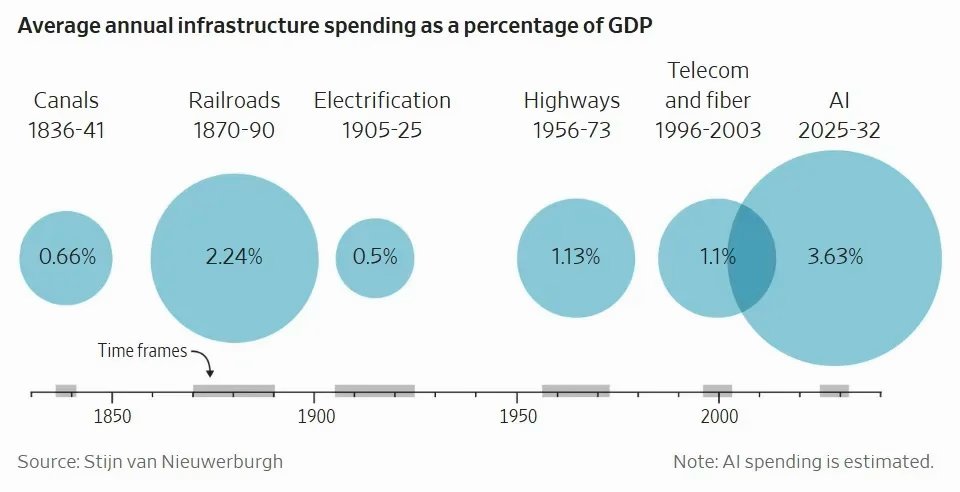 Source: WSJ, using data from Stijn van Nieuwerburgh
As the chart shows, annual telecom and fiber spending during the internet boom averaged roughly 1.1% of GDP.
Meanwhile, estimated AI infrastructure spending from 2025 through 2032 could average 3.63% of GDP!
That's more than three times as much relative to the size of the economy.
Those AI figures are projections, not money already spent.
And today's biggest technology companies have far stronger finances than many dot-com startups did.
But several crucial questions remain unanswered.
What happens if companies build more AI computing power than customers will pay for?
What happens when expensive chips need replacing before their owners have earned back their investment?
And what happens to businesses that rely on fresh borrowing or outside investors to keep expanding?
We saw what happened when similar bets went wrong in 2000.
The investors who piled into internet stocks in 1999 weren't wrong about the technology.
They were wrong about what it was worth.
That's the danger I see in today's AI boom.
A technology can transform the world without delivering the profits needed to justify every stock price, every data center, and every dollar of debt behind it.
And when expectations finally collide with reality, even the strongest companies can see their shares plunge.
That doesn't mean investors should abandon technology or try to guess the exact day a crash will arrive.
It means watching for the same warning signs that preceded the dot-com collapse:
- Spending that outruns revenue.
- Debt that keeps piling up.
- And businesses that can't survive without a steady stream of new money.
I'll continue tracking those risks closely, as I've done throughout our AI House of Cards series.
And as conditions change, we'll be here to help you protect your money, identify companies built to last, and recognize the opportunities that emerge when the dust settles.
Because the lesson of the dot-com crash isn't that investors should fear the future.
It's that you don't have to lose your fortune to be part of it.
Sign Up Today for Free!
Truth & Trends brings you market insights and trading tips you won't find anywhere else — unless you have your own personal hedge fund manager on speed dial...
Meet Enrique Abeyta, one of Wall Street’s most successful hedge fund managers. With years of experience managing billions of dollars and navigating the highs and lows of the financial markets, Enrique delivers unparalleled market insights straight to your inbox.
In Truth & Trends, Enrique shares his personal take on what’s moving the markets, revealing strategies that made him a star in the world of high finance. Whether it’s uncovering the next big trend or breaking down the hottest stocks and sectors, Enrique’s insights are sharp, actionable, and proven to work in any market condition.
Inside these daily updates, you’ll gain:
- 50 years of combined trading wisdom distilled into actionable insights.
- A behind-the-scenes look at how Wall Street pros spot opportunities and avoid pitfalls.
- Exclusive strategies that Enrique personally uses to deliver exceptional returns — no fluff, just results.
To have Truth & Trends sent directly to your inbox every weekday, just enter your email address below to join this exclusive community of informed traders.
Don’t miss your chance to learn from one of the best in the business.
Sign up now and take your trading game to the next level.

Wall Street’s "Fear Gauge" Just Gave You a Raise
Posted November 11, 2026
By Zach Scheidt
A Reckoning for the Riskiest AI Trades
Posted November 10, 2026
By JC Parets

November 5: The Day the AI-pocalypse Began
Posted November 09, 2026
By Enrique Abeyta

Big Tech Wants Inside Your Head
Posted November 06, 2026
By Greg Guenthner

OpenAI Is the Next Bear Stearns
Posted November 05, 2026
By Enrique Abeyta