
Posted November 15, 2026

By Nick Riso
The Chocolate Factory Economy
Come with me, and you'll be…
In a world of pure imagination…
Reach out, touch what was once…
Just in your imagination…
Don't be shy, it's alright…
If you feel a little trepidation…
Sometimes these things don't need…
Explanation…
 AI-Generated Image of Tarek Mansour, Founder of Kalshi
The Wandoggles are quietly speaking to the Goozlers behind closed doors…
Walking through the market these days feels a lot like walking through Willy Wonka’s factory.
Every door opens onto a new room, and every room is full of some confection that didn’t exist a few years ago.
You can buy options that expire the same afternoon you buy them…
You can buy a fund that moves twice as hard as a single stock...
Last month, the SEC approved binary options that pay out based on numbers a company reports, like whether Tesla hits a quarterly figure…
And on Kalshi, you can trade on art auctions, elections, and whether a CEO keeps his job.
As of last week, you can also trade a stock that never expires. That’s the newest room in the factory.
Kalshi, best known for prediction markets, has started listing perpetual futures on individual U.S. stocks, or “perps” for short.
It began on Nov. 4 with Qualcomm, McDonald’s, Amgen and Costco, and announced the launch formally on Nov. 5 with more than 50 names on the menu, Palantir and Meta among them.
For the first time on a U.S.-regulated exchange, we have the chance to lose everything faster than we ever have before.
But that’s being a bit too tongue-in-cheek. I don’t think there’s anything inherently wrong with these things, and we’ll get to exactly what they are and how they work in a minute.
First, though, we have to talk about the fight, because the grown-ups can’t agree on what to call this new candy. Everyone is on the edge of their seats trying to work out what, exactly, a “swap” is.
On Sept. 18, Kalshi asked the Commodity Futures Trading Commission (CFTC), the agency that oversees futures, to approve perpetual futures on single stocks. Coinbase’s derivatives exchange and Bitnomial filed similar requests the same day.
Which agency ends up in charge of this product is the whole fight, so keep that in the back of your mind.
Under the CFTC’s rules, the agency gets 45 days to object to a request like this. If it says nothing, the product is deemed approved. On Nov. 2, the 45 days ran out, and the CFTC said nothing.
There was plenty of noise elsewhere. Cboe, CME, and Nasdaq had all sent objection letters in October, and the Securities Industry and Financial Markets Association (SIFMA), Wall Street’s main trade group, wrote on Nov. 2 asking regulators to stop the products and send them through a full SEC review.
None of it moved the CFTC.
The next morning, CFTC Chairman Michael Selig put out a statement saying the contracts had been “deemed approved” as security futures. There was no vote and no formal order, only a statement from the chairman.
Within hours, a brand-new group called the Capital Markets Alliance sued the CFTC in Manhattan federal court. Its members include Cboe, Citadel Securities, and the Healthy Markets Association.
Their argument hinges on a definition, as most arguments do.
A future is a contract for delivery at some point down the road, and a perp never delivers anything.
So, the alliance says, it can’t be a future. What it really is, they argue, is a “security-based swap,” which belongs to the SEC.
Under that label, retail investors can only trade it on a registered stock exchange with an SEC-approved disclosure document, and no such product exists.
One distinction matters here. The CFTC regulates swaps in general, but swaps tied to individual stocks, called security-based swaps, belong to the SEC. The whole case turns on which side of that line stock perps fall.
The same day the suit was filed, U.S. District Judge Valerie Caproni refused to halt trading, because the alliance hadn’t shown any real, imminent harm…
But she also said the alliance was likely to win.
Because perpetual contracts never provide for future delivery of a stock, she wrote, “they cannot be a security future.”
So the perps keep trading, even though a federal judge has said they probably shouldn’t be. In the factory, you keep eating the candy until a hand actually stops you, not just when someone threatens to.
The fight has only gotten louder since.
On Nov. 6, the CFTC fired back. It pointed out that Cboe itself told regulators in May 2025 that a perpetual can be a futures contract, and that Cboe sells bitcoin “continuous futures” with expirations up to ten years out. It also called the alliance a “sham entity” set up to pick its own courtroom.
Coinbase, Kalshi, Kraken’s parent company Payward, DRW, Jump Trading and Paradigm (no relation…) filed a brief backing the CFTC. Better Markets, joined by two former senior SEC officials, filed one backing the alliance.
And this week, the SEC reportedly sided with the CFTC, without saying whether these things are futures or swaps.
A ruling on whether to shut trading down could come any day. But let’s back up for a minute.
What Are “Perps”?
A perpetual future is a bet on an asset’s price that never expires.
Regular futures contracts have a date stamped on them. And they were built for commodities.
A sawmill and a homebuilder agree today on a price for lumber delivered in March, and that delivery date keeps the price honest.
Say lumber sells for $600 today. If the March contract were still trading at $650 on delivery day, a trader would buy the wood, sell the future and pocket the $50. So the contract can’t stray too far from the real price.
Take the date away, and you need something else to keep the contract tethered.
That’s “funding.” If a lumber perp trades at $650 while the wood sells for $600, the longs pay the shorts every day until the gap closes. Traders short the perp, buy the lumber to cancel out the risk and collect the payments, and their selling drags the price back toward $600. The longs pay rent to stay crowded, and the arbitrageurs collect it.
If the perp trades above the real price because everyone has piled in long, the longs pay the shorts. If it trades below, the shorts pay the longs. The crowded side pays to stay crowded, and the traders willing to lean against the crowd get paid to pull the price back in line.
You put up a slice of the position as margin and get leverage on the rest.
Put up $1,000 at 5x, and you control $5,000 of exposure.
A 10% move your way makes you $500, half your money, and a 10% move against you costs the same. If your margin runs too thin, there’s no phone call from a broker asking for more cash. A machine simply closes the position for you.
Perps aren’t new.
The economist Robert Shiller sketched the idea in 1993, and a crypto exchange called BitMEX launched the first real one, on bitcoin, in 2016.
Since then, they’ve become the main way crypto trades. Perp volume hit $61.7 trillion in 2025, according to CryptoQuant. Kalshi itself started offering crypto perps in June.
What’s new is pointing them at stocks, here, on a regulated U.S. exchange.
What Are Perps on Stocks?
Think of it as the same machine, with different candy coming out the other end.
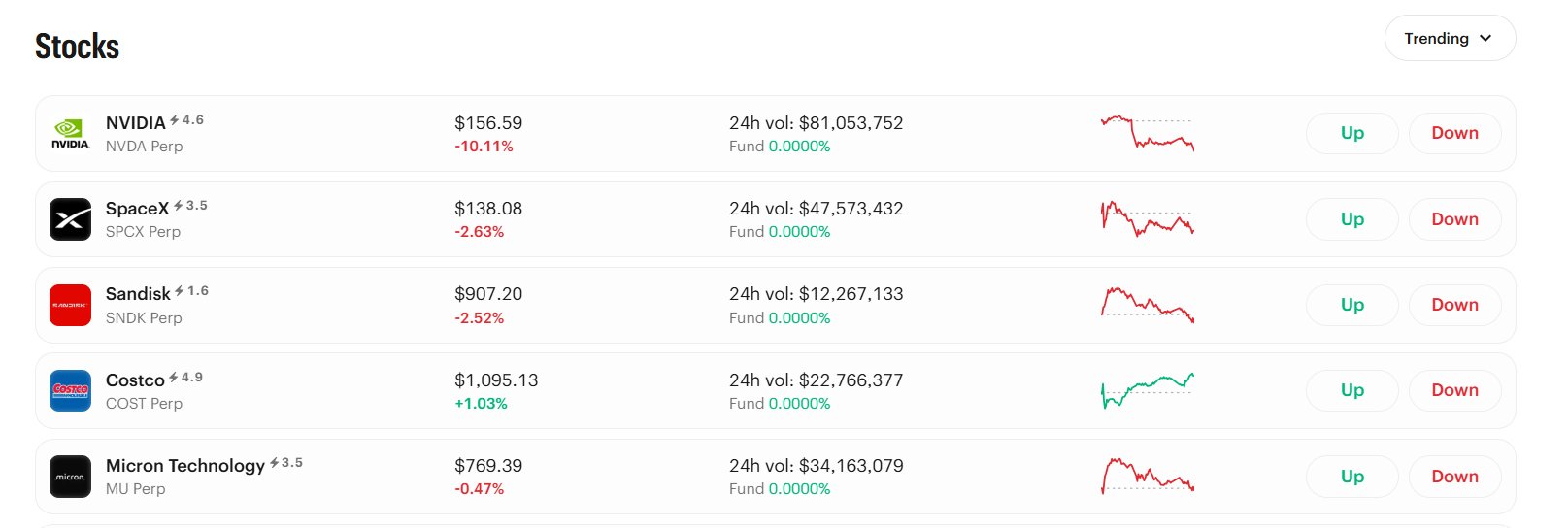
A stock perp tracks a single company’s share price. You can go long or short without owning or borrowing a single share, and you never have to roll the position.
On Kalshi, each contract is worth 0.02 shares, so 50 contracts equal one share. Funding settles once a day at 4 p.m. ET. Leverage varies by stock and launched capped at 4.9x. And unlike most of the offshore versions, Kalshi passes dividends through in cash: longs receive them and shorts pay them.
The product has existed offshore for a while. Hyperliquid, Binance, Bitget, OKX, Kraken and Coinbase’s international exchange all list stock perps for non-U.S. customers, often at 10x to 25x leverage.
Kalshi says single-stock perps trade more than $4.5 trillion a year on those venues. Until this month, Americans were locked out. Good for us!
That’s why the CFTC’s silence carried so much weight. With it, the agency opened the door to a whole category of trading that grew up overseas, and it did so through the futures regulator rather than the securities regulator.
Stocks don’t trade around the clock, but most offshore stock perps do. On a Saturday, the perp is the price with nothing underneath it until Monday’s open, which is an interesting theoretical issue to think about. Kalshi chose not to go there, which is honestly, as things stand today, a good thing.
Its stock perps close on a schedule, so you can’t trade them while the market is shut, and you carry whatever gap opens up into the reopen.
Early volume numbers are hard to pin down.
Kalshi says more than $300 million traded on the first day. Ledger Insights counted about $23 million in the first 24 hours on the first four contracts.
Both could be true over different windows… and like most things nowadays, neither is audited.
Is This Crazy?
Well, yeah. But I don’t know that it poses an immediate systemic problem.
Kalshi caps leverage below 5x, trades are centrally cleared, and customer money sits with a regulated futures broker. That’s a lot more protection than the offshore venues offer.
Compare it with Oct. 10, 2025, when crypto perp markets liquidated more than $19 billion of positions in about a day, by Coinglass’s count.
But it is the next logical step toward “overfinancialization.”
Kalshi CEO Tarek Mansour calls stock perps “simple and easy to trade.” Better Markets’ legal director counters that at roughly six times leverage, a 16% move can zero out an investor’s entire position.
Both of those things are true at the same time, and that’s what, I guess, could be considered “scary.”
These aren’t products built for holding. When ICE CEO Jeff Sprecher laid out the NYSE owner’s own plans for perps last month, he noted that the average holding period on a perpetual oil contract in September was 12 hours.
I think the demand speaks to something real.
A lot of people, especially younger people, feel like they’re behind. The traditional route to building wealth looks slow and mostly closed off to them, so they’re reaching for the fastest-moving vehicle on the lot.
It’s something we call “financial nihilism,” and I don’t think it’s something to dismiss without a second thought.
Wonka’s factory was a wonderful place. Things made sense, things felt good. We were eating the cups.
And then old Augustus got a little greedy. And we all watched in horror as he got sucked up the pipe.
Sign Up Today for Free!
Truth & Trends brings you market insights and trading tips you won't find anywhere else — unless you have your own personal hedge fund manager on speed dial...
Meet Enrique Abeyta, one of Wall Street’s most successful hedge fund managers. With years of experience managing billions of dollars and navigating the highs and lows of the financial markets, Enrique delivers unparalleled market insights straight to your inbox.
In Truth & Trends, Enrique shares his personal take on what’s moving the markets, revealing strategies that made him a star in the world of high finance. Whether it’s uncovering the next big trend or breaking down the hottest stocks and sectors, Enrique’s insights are sharp, actionable, and proven to work in any market condition.
Inside these daily updates, you’ll gain:
- 50 years of combined trading wisdom distilled into actionable insights.
- A behind-the-scenes look at how Wall Street pros spot opportunities and avoid pitfalls.
- Exclusive strategies that Enrique personally uses to deliver exceptional returns — no fluff, just results.
To have Truth & Trends sent directly to your inbox every weekday, just enter your email address below to join this exclusive community of informed traders.
Don’t miss your chance to learn from one of the best in the business.
Sign up now and take your trading game to the next level.
Nvidia Bankrupt by Thanksgiving?!?
Posted November 13, 2026
By Greg Guenthner

The Cruel Irony of the Dot-Com Crash
Posted November 12, 2026
By Enrique Abeyta
Wall Street’s "Fear Gauge" Just Gave You a Raise
Posted November 11, 2026
By Zach Scheidt
A Reckoning for the Riskiest AI Trades
Posted November 10, 2026
By JC Parets

November 5: The Day the AI-pocalypse Began
Posted November 09, 2026
By Enrique Abeyta