Posted November 22, 2026

By Nick Riso
The Billion-Dollar “Buy Signals” That Lead Nowhere
Gee whillikers!
Berkshire Hathaway just bought more Delta Air Lines, bringing its stake to over 64 million shares worth $5.4 billion.
That’s according to its most recent 13F report, filed on Monday.
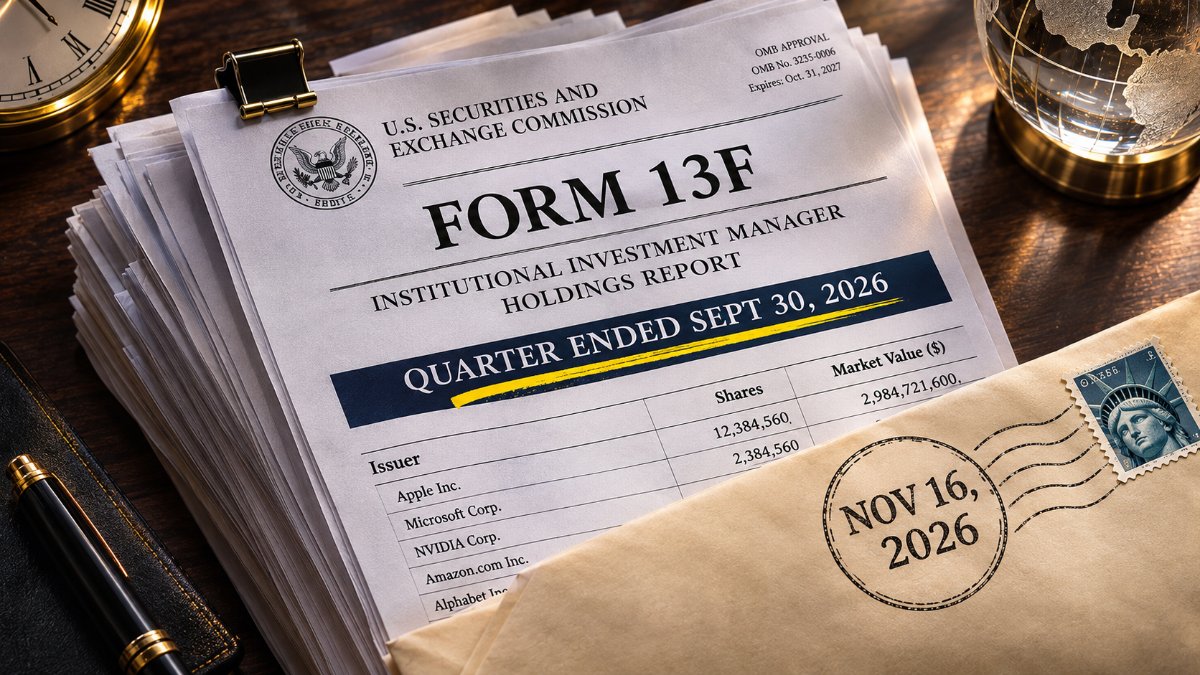
If you aren’t familiar, 13Fs are documents filed with the Securities and Exchange Commission (SEC) each quarter by some of the world’s biggest institutions, hedge funds, quant funds, and stock pickers.
A lot of the retail crowd considers this an incredible buy signal.
I mean, hey, if Warren Buffett disclosed he bought billions of dollars of a stock, why in the world wouldn’t you follow one of the best investors of all time? (I know Warren is not the CEO anymore.)
I like things like this because it feels so obvious.
But an iron law of retail finance is that things that seem so obvious are usually not so because the world of finance is incredibly complex.
Thousands of quant firms, market makers, or high-frequency traders know what you’re going to do (because it’s the obvious thing to do) and use that information to extract money from you.
We’re operating in minutes while they’re operating in milliseconds. With 13Fs, it’s even worse. We’re operating in months.
But I do think it’s still worth looking into and asking… with public filings, is this still the case?
Everyone gains access at the same time, right? Does watching SEC filings for big money moves help generate returns? Do 13Fs give you an edge?
The latest deadline for third-quarter 13Fs was Nov. 16.
Let’s take a look at a bunch of stocks, what the 13Fs said about them, and importantly, what the share price did next.
CHIPS
Nvidia Corp. (NVDA)
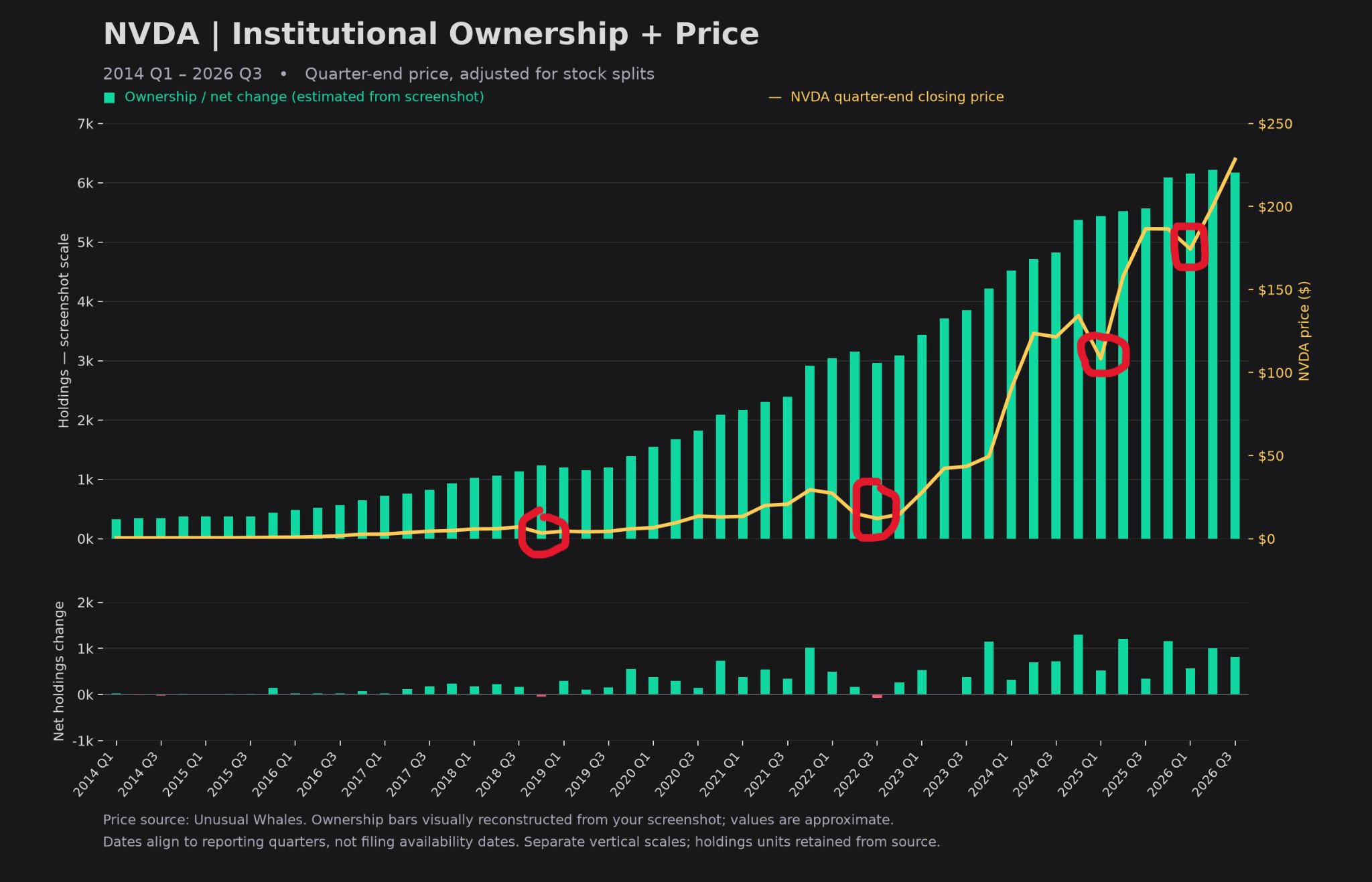
For each one of these, we’ll look at total institutional holdings (via 13F) and net changes over time. Green is positive, red is negative, and the yellow line is the share price.
The subtlety on this one is tough to grasp at first, so I’ve circled a few areas of interest. Look at the price (yellow line), net holdings (green bars behind the yellow line), and net changes (smaller green and red bars).
Generally speaking, there seems to be a lagging effect. That’s baked into the rules. Funds have up to 45 days after a quarter ends to file, and the filing only shows what they held on the last day of that quarter. So by the time you read it, you could be looking at a position that’s four months old.
Think about it like this: If you see that a bunch of institutional investors sold out of their position in a stock like Nvidia, wouldn’t you want to know before it happened and not when the price has bottomed?
By the time you read their report or saw it in the headlines, you were too late!
Of course, if you’d known what they had bought before they did, you would’ve done well. But this is a pipe dream, right? (Well, maybe not. But I’ll get to that in a moment.)
Nvidia is tough because it’s a storied stock that’s experienced a few downdrafts along the way, but it’s mostly gone up, as we can see via the yellow line.
The most recent quarterly filing looks like this:
- Hedge funds piled in during Q3. GQG Partners added 11.1 million shares, bringing it to 14 million, about 6% of its entire 13F book. Sanders Capital, AQR and Marshall Wace each added 6 million to 7 million shares.
- Renaissance went the other way, from 7.1 million shares to 23,000.
- Nvidia was $228 on Sept. 30 and $151 on Nov. 18, down 34%. In between, Jensen Huang resigned as CEO and CFO Colette Kress was named interim CEO.
Now let’s keep going.
Micron Technology Inc. (MU)
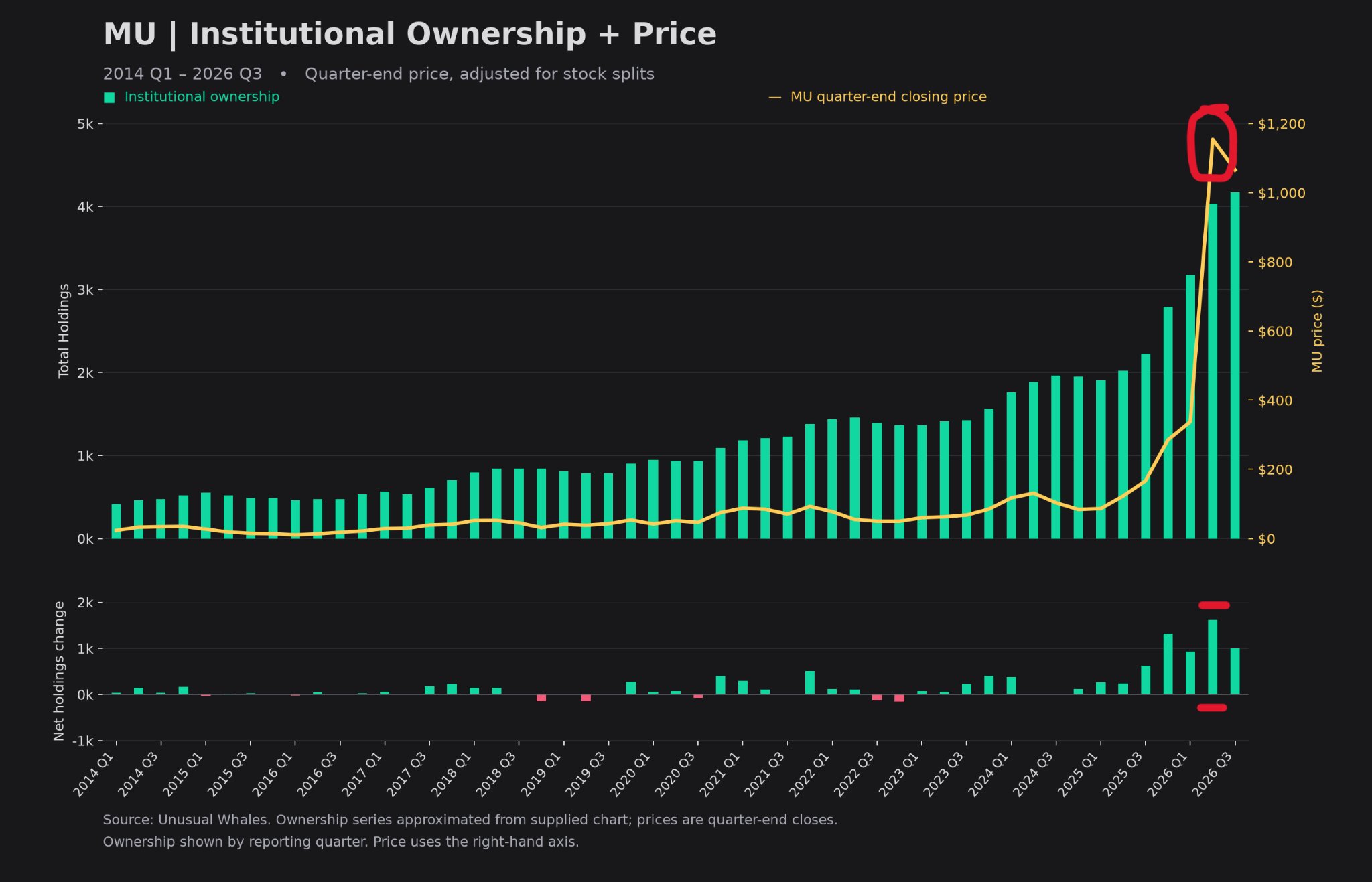
Micron is a good example because it’s been a favorite among retail investors, traders, and institutions over the past year.
A big chunk of the AI trade this year rotated into memory chip names, and Micron was the poster child of that.
There isn’t a ton to see in the chart above, but I’ve highlighted the lag in red, which we started to see with Nvidia.
Now, Micron might be a bad example in the same sense as Nvidia. It’s been up; so if you bought in 2024, you’re up without needing institutional moves.
But the question we started with is if 13F filings give you an edge on their own.
From the chart above, definitively not. You can see with your own eyes that the second quarter brought the largest net change in institutional ownership on the whole chart… and by the time those filings were due on Aug. 14, the stock had already peaked!
Micron closed at $1,213 on June 25. By the deadline, it was $972. If you relied on the 13Fs alone, you’re losing money.
And if you somehow got in before those filings, of course, you’d have made a killing.
Just for some context, here are the most recent filing highlights:
- Arrowstreet went from 291,000 shares to 2.4 million. GQG opened a 1.3 million-share position, and Renaissance added 1.3 million.
- Rowe Price cut 2.5 million shares.
- Micron was $1,065 on Sept. 30 and $707 on Nov. 18, down 34%.
Intel Corp. (INTC)
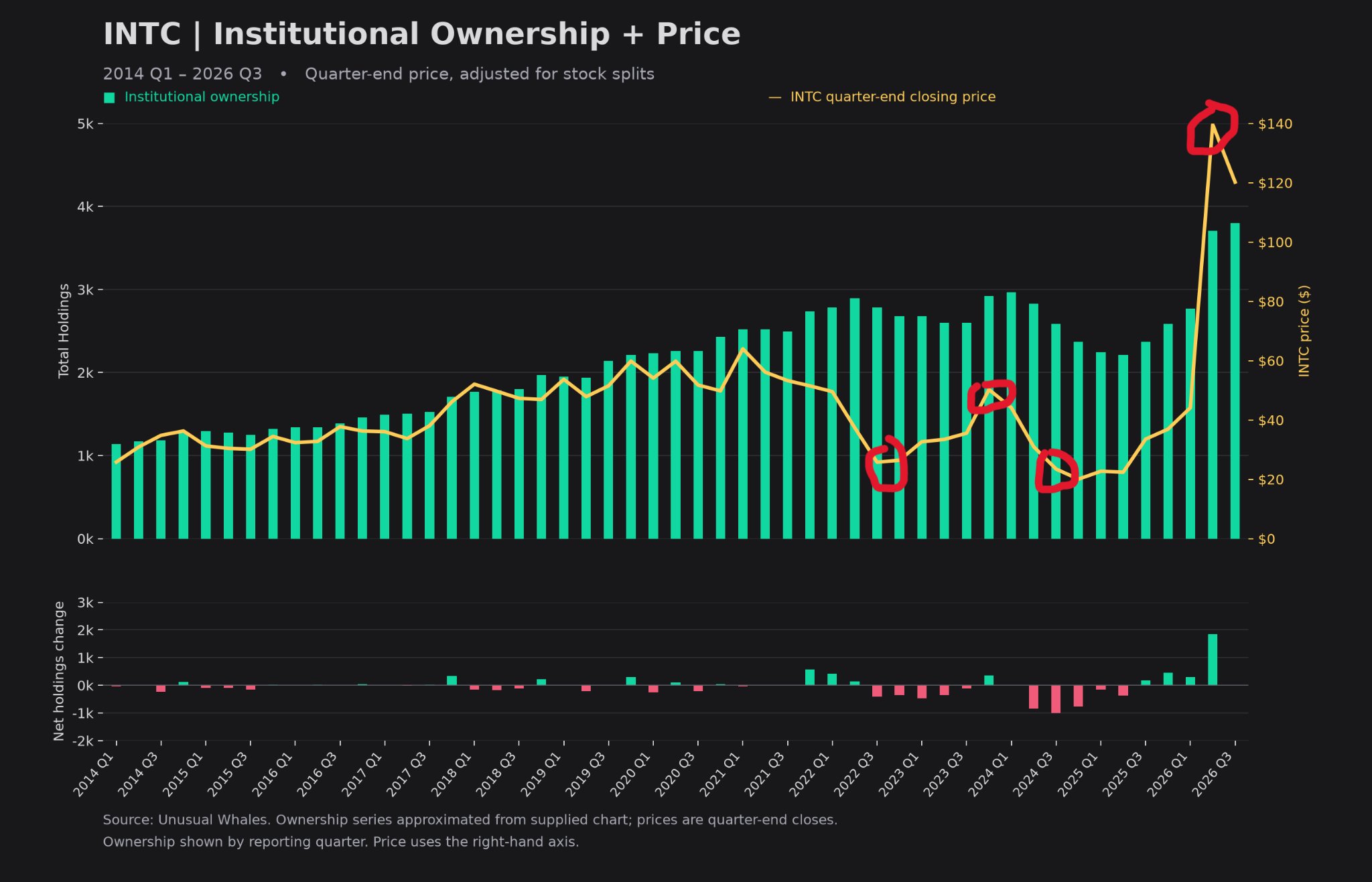
Good ole Intel.
It’s had a lot of fundamental issues and dizzying stories surrounding it for a few years.
Can it compete on a global scale… is it innovative enough… can U.S. tech get everything it needs from Taiwan Semiconductor? And on and on.
Those types of questions seem to be playing out in how institutions are thinking about it as well. It’s a mixed bag. And so any investor trying to understand what they should be doing with the stock by using these giant Ivy League brains as their north star has been largely disappointed.
Even the latest runup in price! We can see that in the second quarter.
Net changes skyrocketed. But if you were waiting for the filings, you were too late. Intel closed at $141 on June 22. By the Aug. 14 deadline, it was $102.50, already 27% off the high.
If only we knew what these fund managers were doing beforehand, before that major runup.
Here’s the latest:
- GQG opened a new position of 9.6 million shares, about $1.16 billion. Ghisallo bought 5 million shares, and T. Rowe, Walleye, AQR and Marshall Wace each added 5 million to 7 million.
- Qube is the tell. It owned no Intel in Q1, had 4.7 million shares by the end of Q2, and was down to 814,000 by Sept. 30. If you’d bought off the Q2 filing, you were buying just as Qube was getting out.
- Then Intel fell about 29% on October 30, a day after giving a fourth-quarter forecast well below what analysts expected.
- Intel was $120 on Sept. 30 and $55 on Nov. 18, down 54%.
BIG TECH
Apple Inc. (AAPL)
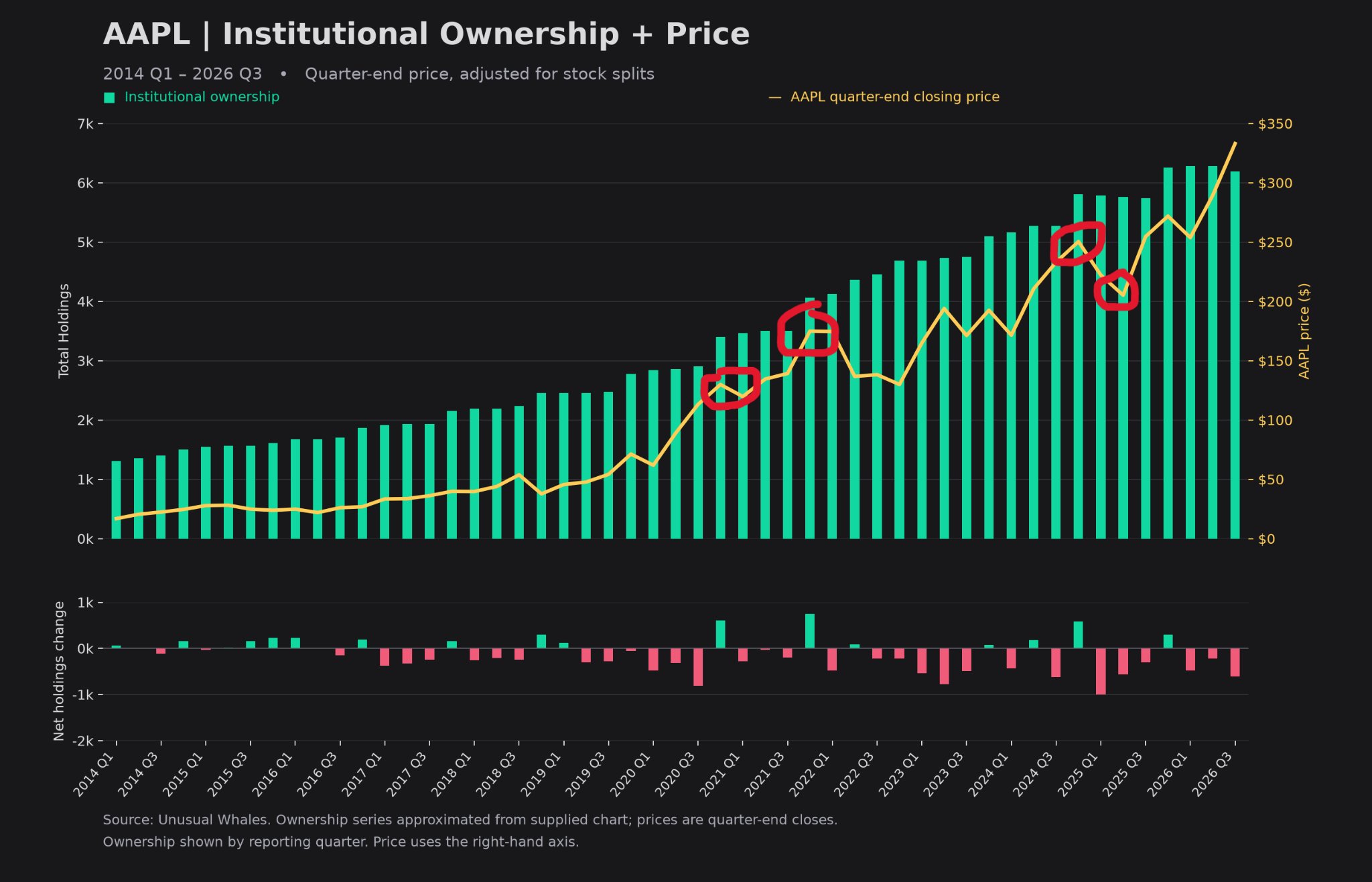
Apple is an interesting look.
But it’s the same as the others. You’re getting it by now, I’m sure. Take a look at net changes at the bottom and compare that to price.
Look at the bottom panel. Red bar after red bar. Institutions were net sellers in most quarters going back to 2017, and the stock went from under $40 to over $330 anyway.
Now say you read that a big fund just loaded up on Apple last quarter (GQG Partners actually did) and you thought it was the perfect time to get in. You’re probably too late.
If you’d gotten in a quarter before that fund, well, that’s a different story.
If you could model a manager’s brain and trading style, well, of course you could choose stocks before them and get in before these big players file.
Latest quarter filing:
- GQG went from 1.3 million shares to 7.4 million. AQR and Quantinno added about 3 million each.
- Arrowstreet cut 12.2 million shares.
- Apple was $333 on Sept. 30 and $353 on Nov. 18, up 6%.
Alphabet Inc. (GOOGL)
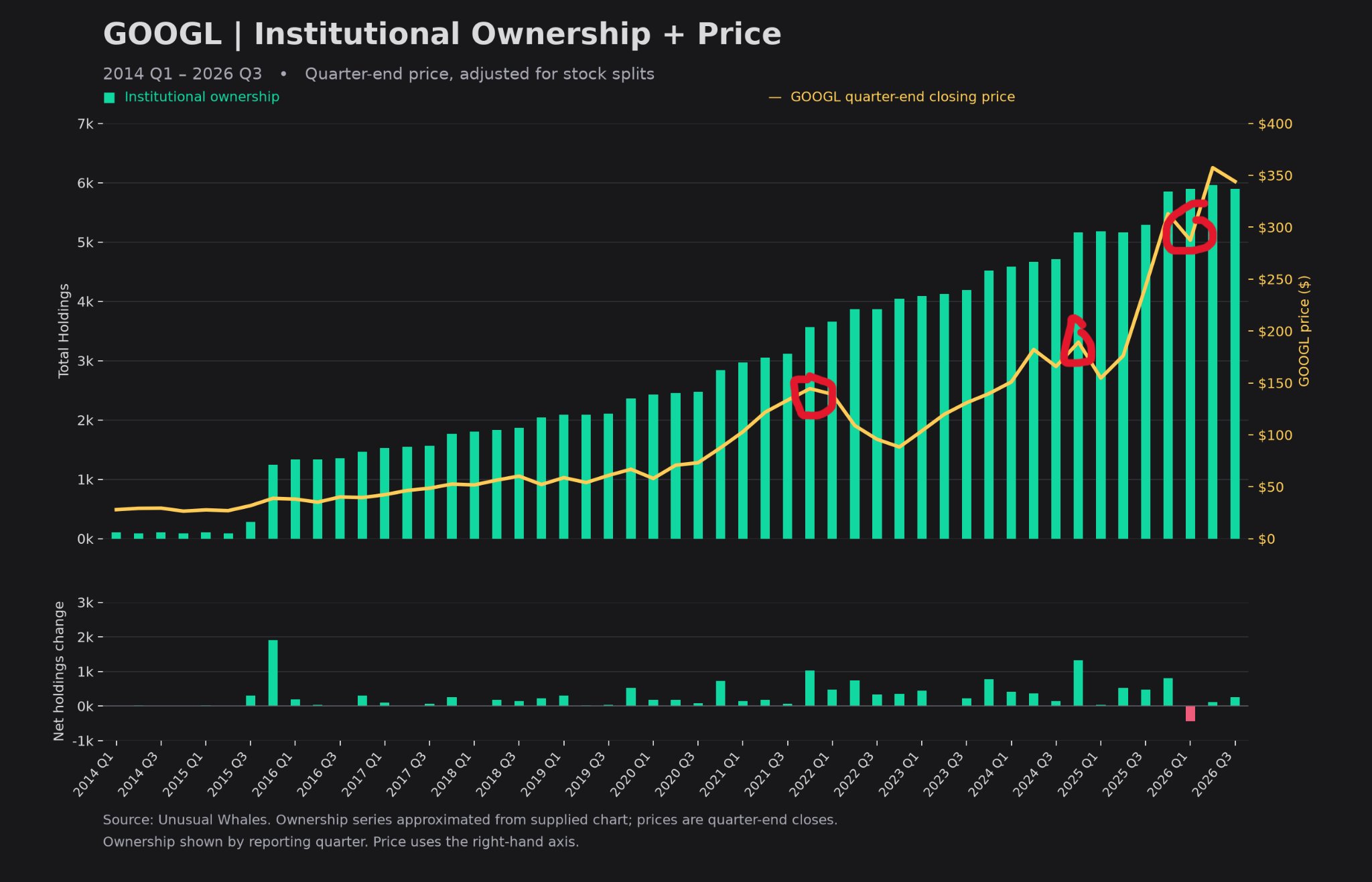
Google is more of the same.
Look at late 2021. That was one of the biggest quarters of net buying on the chart, and by the time those filings came out in early 2022, it was time to sell.
Then look at early 2026, the one quarter institutions were net sellers. That selling showed up right at a dip, just before the stock ran to new highs.
Where does the edge exist?
Latest report:
- Millennium went from 94,000 shares to 1.9 million. Holocene, Marshall Wace, Walleye and Qube each added 1 million to 1.6 million.
- Jericho Capital sold all 1.1 million of its shares.
- Then Alphabet slid over 9% after hours on its October earnings.
- Alphabet was $344 on Sept. 30 and $285 on Nov. 18, down 17%.
We could do this all day with tech, so let’s take a look at a couple other sectors and sub-sectors to see if an edge exists there.
FINANCIALS
JPMorgan Chase & Co. (JPM)
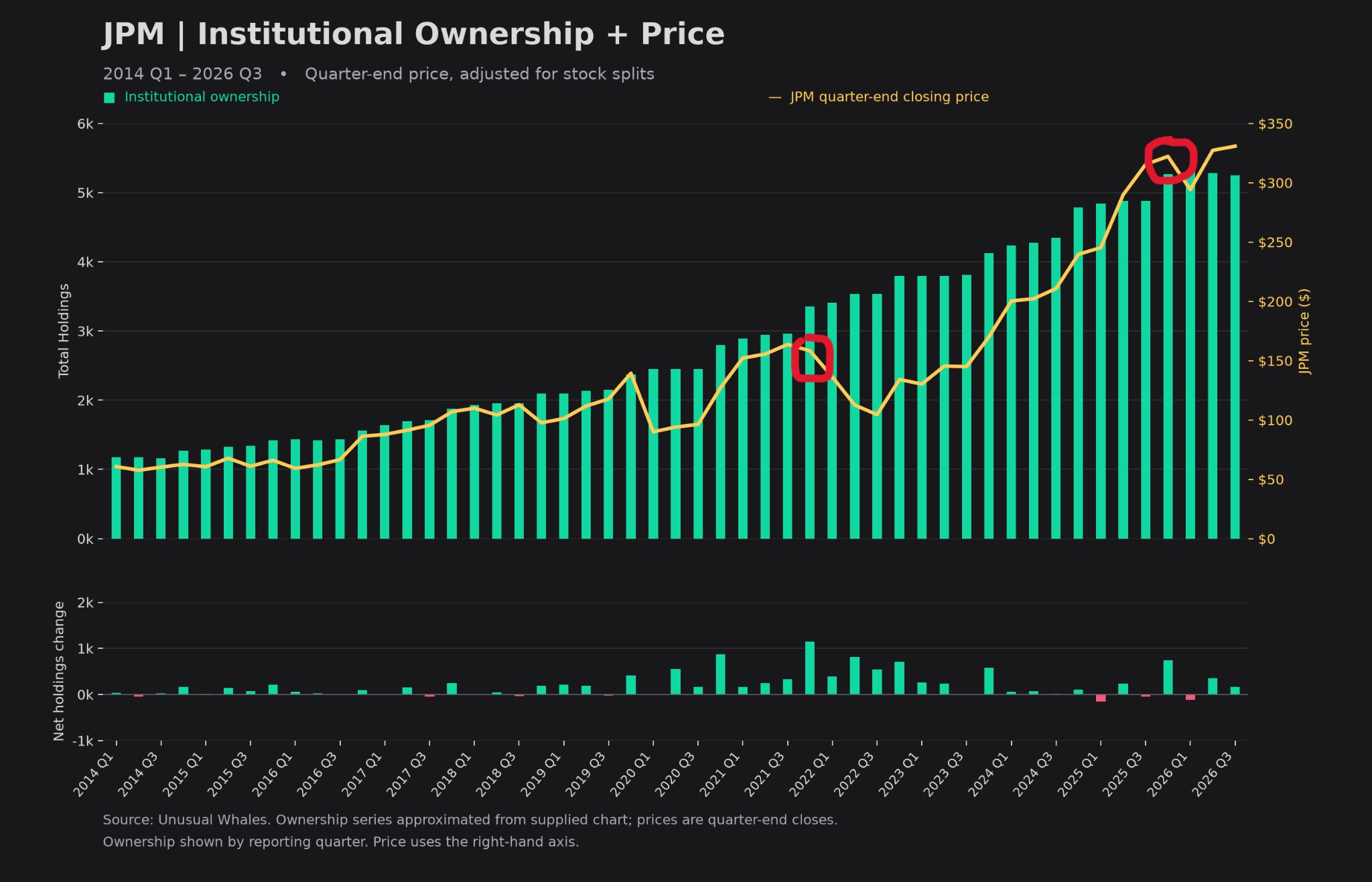
Not much to see here. Same pattern exists for JPMorgan. So let’s get into a few other banks.
But first, a little more granular from this past quarter:
- Axiom and Acadian added more than a million shares each.
- MKP Capital opened a position in Q1, built it to 1.4 million shares in Q2, and sold every share in Q3. All you’d ever see of that trade is two snapshots.
- JPMorgan was $331 on Sept. 30 and $324 on Nov. 18, down 2%.
Bank of America Corp. (BAC)
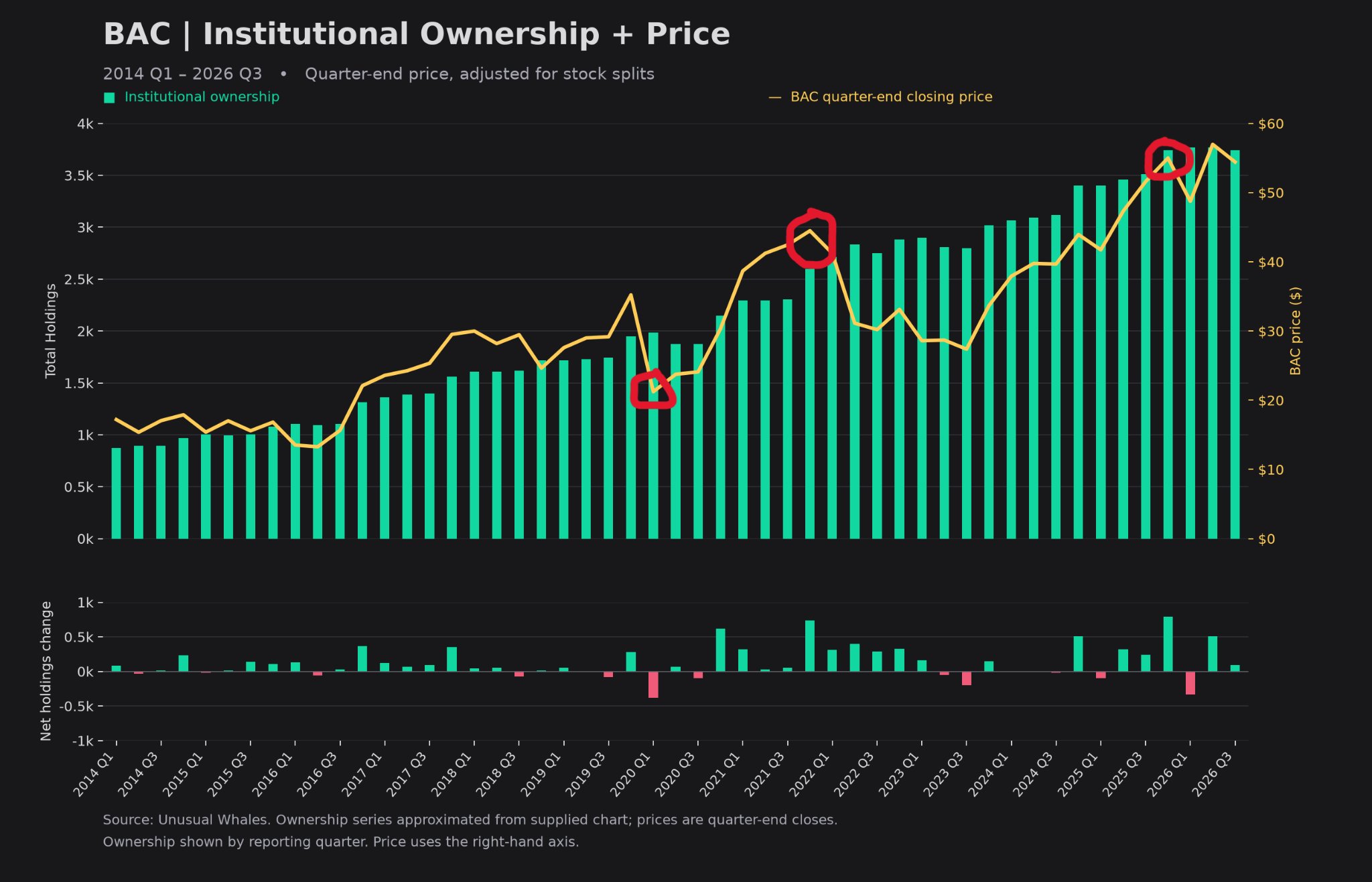
Yawn! Is there any difference here? You can certainly read the charts by now.
This most recent quarter:
- The biggest seller tagged as a hedge fund was T. Rowe Price, which cut 22.4 million shares, about $1.2 billion. T. Rowe is a mutual fund company. Always check who’s actually inside those red bars.
- Marshall Wace cut from 12.5 million shares to about 25,000.
- The quants took the other side: AQR doubled to 19.7 million shares, and Renaissance opened a 6.5 million-share position.
- Bank of America was $54 on Sept. 30 and $49 on Nov. 18, down 10%.
The Goldman Sachs Group Inc. (GS)
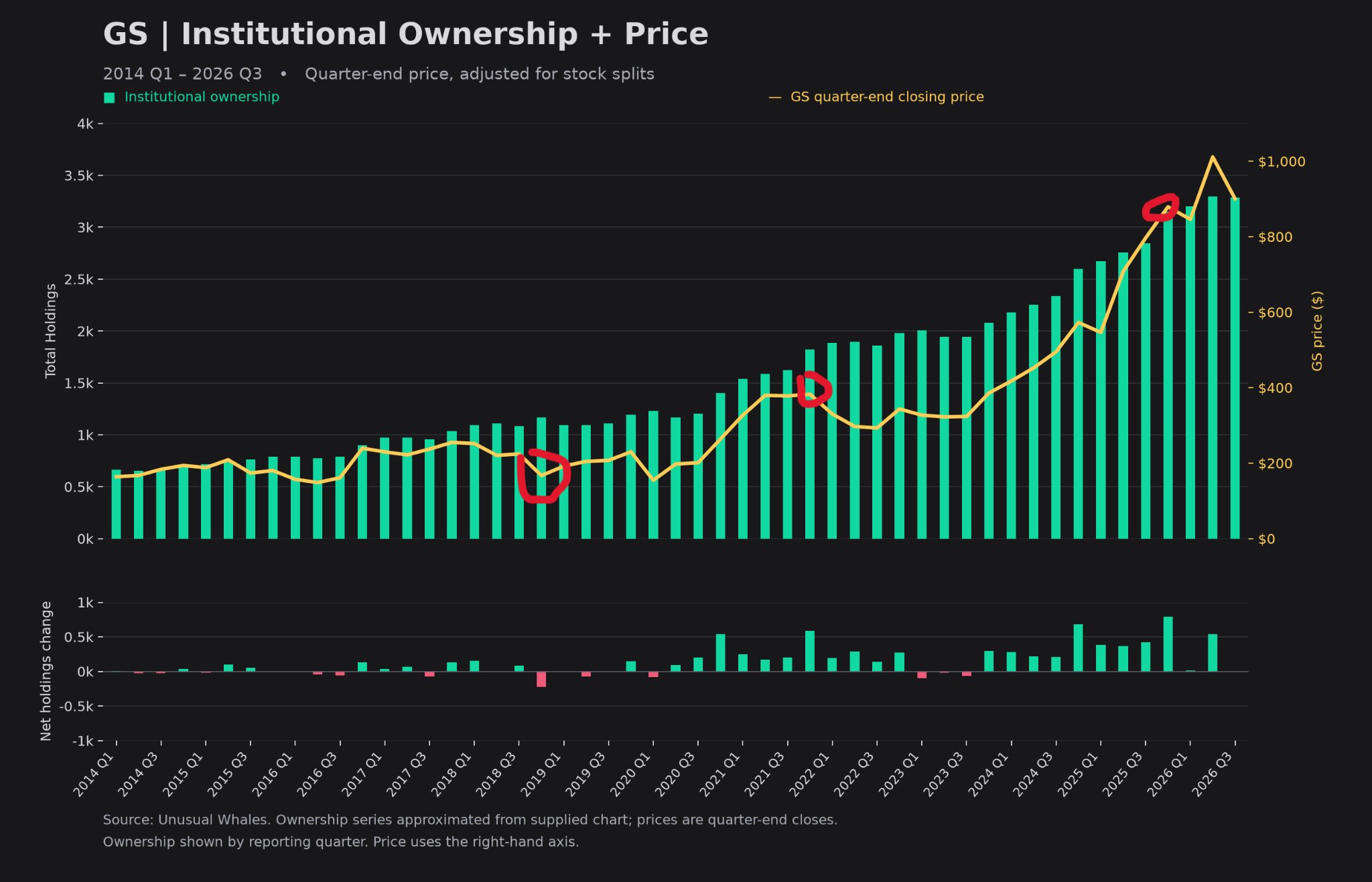
Same old, same old.
Before we move on from financials altogether, here’s the latest for GS:
- AQR doubled its stake to 985,000 shares, and Renaissance opened a 272,000-share position.
- Boston Partners cut from 949,000 shares to 163,000.
- Goldman was $900 on Sept. 30 and $873 on Nov. 18, down 3%.
BIOTECHS/HEALTHCARE
Now this last category gives me some hope. Biotechs are typically seen by Main Street as the insider haven.
Complex drug chemistries live within indecipherable code, and the people on the inside tend to have a lot more specialized knowledge than someone like me, who just knows that mitochondria is the powerhouse of the cell.
They can assess for themselves whether the drugs they’re working on are actually working. And whether the one shot that the company has at securing FDA approval hinges on this one drug.
UnitedHealth Group Inc. (UNH)
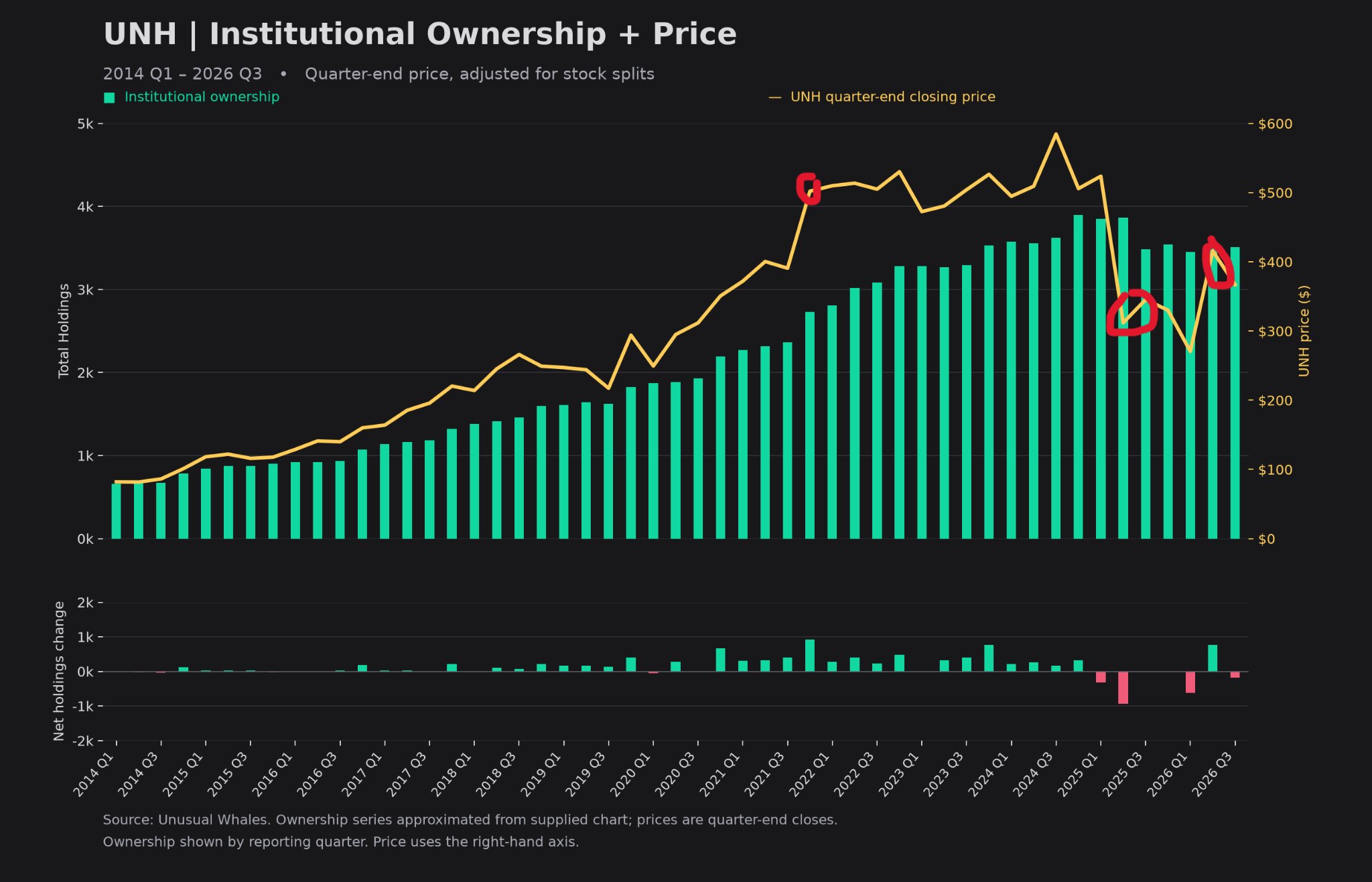
All the same, pretty much. But UNH isn’t a biotech; it’s health insurance.
So after the most recent filing updates, we’ll look at a big healthcare company and then a big biotech:
- This is the classic 13F story. When Berkshire revealed a new UnitedHealth stake last year, the stock jumped more than 12% in premarket trading.
- In Q3 2026, Renaissance went from 367,000 shares to 2.2 million. GQG opened a 1.2 million-share position.
- Marshall Wace cut from 1.8 million shares to 252,000.
- UnitedHealth was $367 on Sept. 30 and $350 on Nov. 18, down 5%.
Eli Lilly and Co. (LLY)
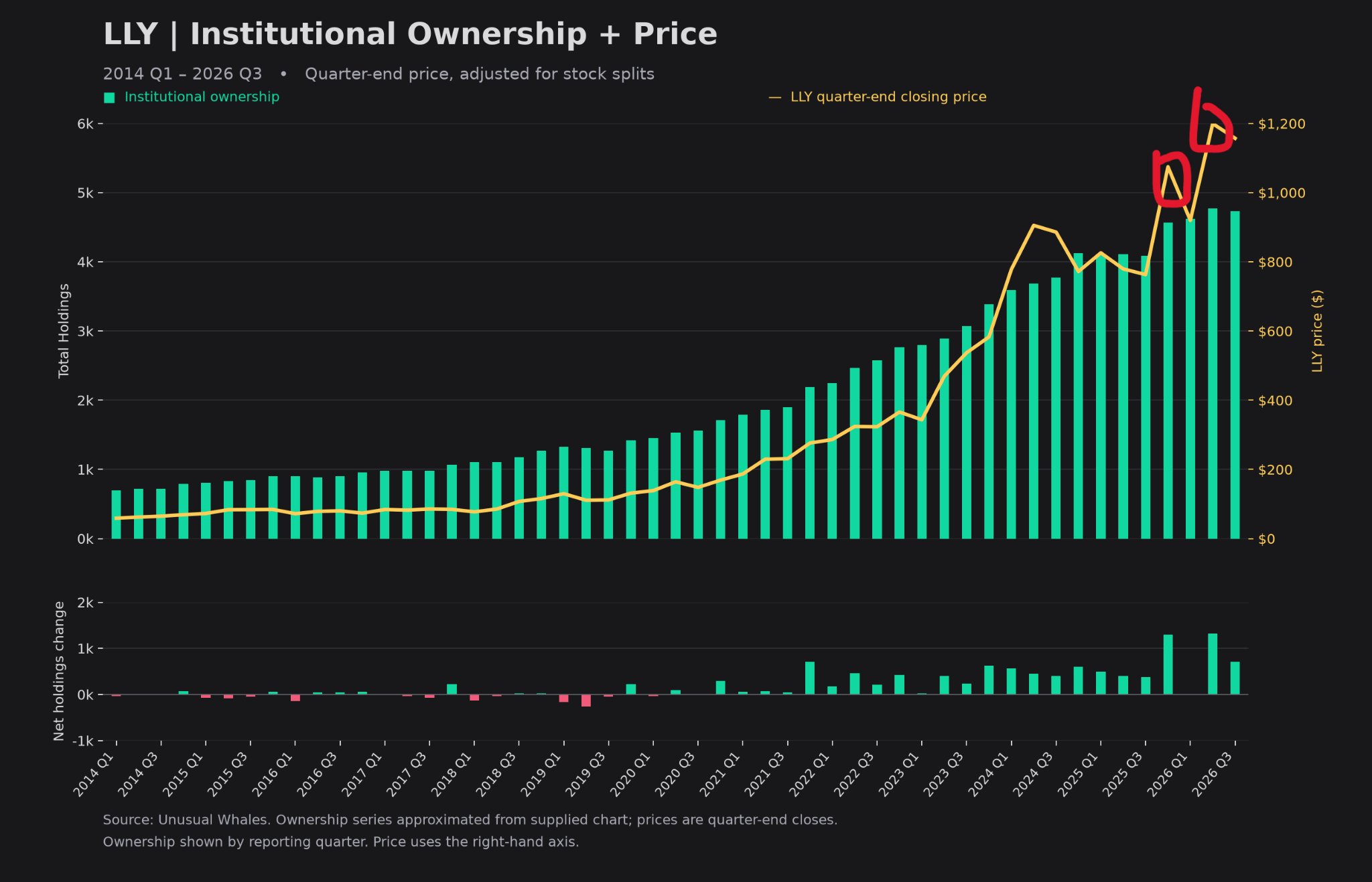
It would’ve paid had you known what these big players were adding before they added them. But of course…
Now here’s what the latest filing says:
- GQG opened a new position of 759,000 shares, about $878 million. Two Sigma went from 81,000 shares to 339,000.
- Qube cut from 346,000 shares to 829, and Schonfeld cut from 240,000 to 26,000.
- Lilly was $1,157 on Sept. 30 and $1,383 on Nov. 18, up 20%.
Vertex Pharmaceuticals Inc. (VRTX)
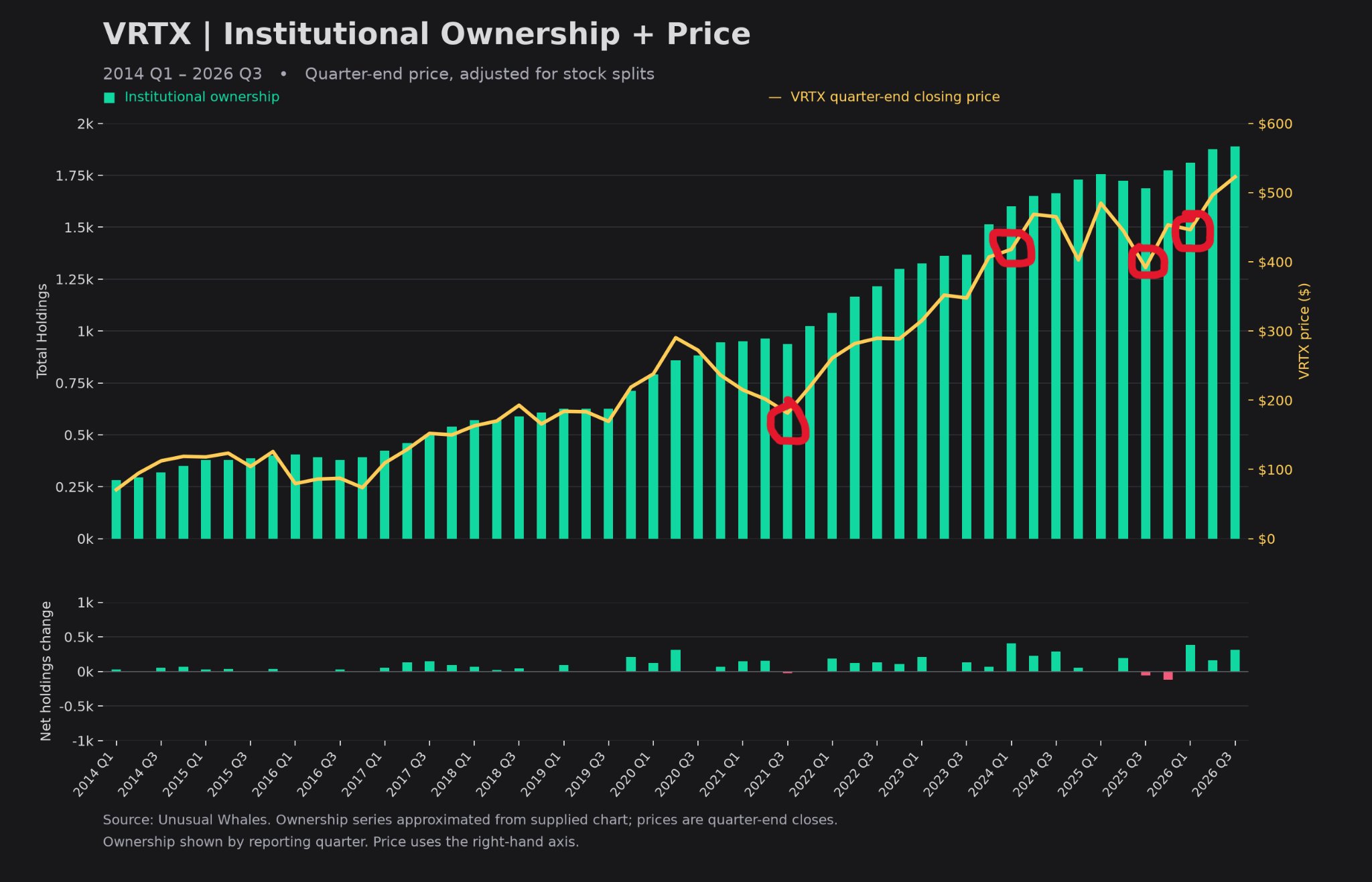
Vertex is the most interesting because it’s possible to have worked in some places, as you can see.
The red circle is there, larger than usual net increase in institutional holdings, price follows higher.
But I’d also say it’s inconsistent at best.
- The biggest “hedge fund” buyers were Jennison and Victory Capital, which are traditional asset managers. On the other side, AQR, Hudson Bay and Two Sigma made small cuts.
- Vertex was $523 on Sept. 30 and $536 on Nov. 18, up 3%.
So what now?
I think the biggest question following this is not necessarily what we’ve established already, that there doesn’t seem to be an edge for retail investors or traders like us in reading 13Fs alone and finding which funds are buying or selling stocks.
I think the biggest question is that these are institutions filing a buy and the stock doesn’t go up.
What?
Thing is, 13Fs themselves are just disclosures.
Let’s say a big hedge fund is short a huge position in Tesla. They buy a bunch of call option positions to hedge against tail risk — in case they’re wrong, they want to limit their losses.
In a 13F sense:
- That short sale doesn’t have to be reported.
- That options position alone will.
- Retail will see the notional value of the options position and think the fund is majorly bullish on Tesla and buy.
Something like this happened with Michael Burry. In 2025, his fund’s 13F showed put options on Palantir with a notional value of $912 million. Headlines called it a billion-dollar bet against the stock.
Burry said he’d actually paid $9.2 million. And earlier that year, his own filing flat-out warned that the puts it disclosed “may serve to hedge long positions” that didn’t have to be reported.
Now what we were talking about earlier… if you can know what these Wall Street big cats are doing before they do it, before they buy and file, that’s where any sort of edge would be. But that’s impossible, right?
Up until now, I’d say yes.
That’s the whole problem with 13Fs. The filing always shows up late. By the time you read it, the money has already been made by someone else.
But AI is changing that.
Imagine knowing which stocks Warren Buffett, George Soros, or Paul Tudor Jones were going to buy… before they bought them. Before the filing. Before the headline. Before the stock moves.
That’s the holy grail. And James Altucher has been chasing it with AI for 20 years.
He’s no newcomer to this. He helped work on Deep Blue, the IBM computer that beat Garry Kasparov at chess. He ran a $60 million hedge fund, partly on AI trading algorithms he wrote himself.
And even he couldn’t crack it.
Then a contact from MIT’s Artificial Intelligence Lab got him access to a powerful type of AI called a “world model.”
It’s the same type of AI Elon Musk is using to train Tesla’s self-driving cars.
A world model learns how something behaves, so it can predict what happens next. A car merging. A light turning red. A pedestrian stepping off the curb.
So we pointed it at the stock market. That’s when it clicked.
Every great secret project has a code name. We call this one Project AI Clone.
We trained it on billions of data points from some of the best investors on the planet. It’s designed to predict which stocks they’re likely to buy next.
If you’re skeptical, good. You should be.
On Tuesday at 1 p.m., we’ll show you everything. Then you can decide if it’s real.
Sign Up Today for Free!
Truth & Trends brings you market insights and trading tips you won't find anywhere else — unless you have your own personal hedge fund manager on speed dial...
Meet Enrique Abeyta, one of Wall Street’s most successful hedge fund managers. With years of experience managing billions of dollars and navigating the highs and lows of the financial markets, Enrique delivers unparalleled market insights straight to your inbox.
In Truth & Trends, Enrique shares his personal take on what’s moving the markets, revealing strategies that made him a star in the world of high finance. Whether it’s uncovering the next big trend or breaking down the hottest stocks and sectors, Enrique’s insights are sharp, actionable, and proven to work in any market condition.
Inside these daily updates, you’ll gain:
- 50 years of combined trading wisdom distilled into actionable insights.
- A behind-the-scenes look at how Wall Street pros spot opportunities and avoid pitfalls.
- Exclusive strategies that Enrique personally uses to deliver exceptional returns — no fluff, just results.
To have Truth & Trends sent directly to your inbox every weekday, just enter your email address below to join this exclusive community of informed traders.
Don’t miss your chance to learn from one of the best in the business.
Sign up now and take your trading game to the next level.

Thanks for Nothing, Druckenmiller
Posted November 20, 2026
By Greg Guenthner
Ghosts of '08 and the Warnings Ignored
Posted November 19, 2026
By Enrique Abeyta

The "Touch-and-Go" Trade: How to Turn One Win Into Two
Posted November 18, 2026
By Zach Scheidt
The Financial Crisis Everybody Sees… Except Banks
Posted November 17, 2026
By JC Parets
BUY NVIDIA Before Earnings Tonight!
Posted November 17, 2026
By Enrique Abeyta