
Posted July 13, 2026

By Enrique Abeyta
The Biggest IPO You Never Heard About
SpaceX was all the investing world could talk about in the weeks before the IPO.
Even people with little interest in the stock market seemed to know that SpaceX was finally going public.
It was a cultural event and bigger than any IPO in history.
Just last week, another company completed a historically large public offering, second only to SpaceX.
That company is SK Hynix, one of the most important names in the future of AI.
But its IPO last week barely registered outside of Wall Street.
There were no countdowns. No viral X posts. No endless television coverage. Most people didn’t even realize that it happened.
This raises an interesting question.
How could one of the biggest IPOs in history receive so little attention?
The answer reveals something important about the difference between the companies that capture our imagination and the companies that make those dreams possible.
A Blockbuster IPO Without All the Fanfare
SK Hynix was founded in South Korea more than 40 years ago.
It’s the world's second-largest memory chip manufacturer and one of the most important companies powering the AI revolution.
The name may not ring a bell to most people. But it started as Hyundai Electronics, which should sound familiar.
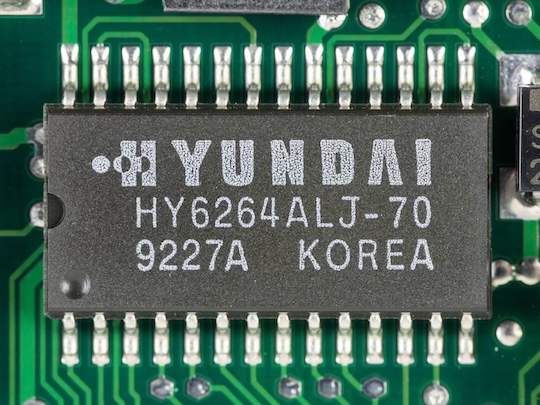 A Hyundai SRAM in a Seagate Hard Drive (ST351A-X), Circa Early 1990s. Source: Raimond Spekking / CC BY-SA 4.0 (via Wikimedia Commons)
Unlike Nvidia, which designs the graphics processors, SK Hynix manufactures the specialized memory chips that allow those processors to perform at their full potential.
It’s become the global leader in High Bandwidth Memory (HBM), an advanced form of memory capable of moving enormous amounts of data at incredible speeds.
That may not sound exciting at first.
But imagine building the world's fastest race car and then trying to feed the engine through a drinking straw.
No matter how powerful the engine is, it can never reach its full potential.
AI faces the same challenge.
For every ChatGPT answer, AI-generated image, and data center training the next generation of LLMs, staggering amounts of information must move between processors and memory almost instantaneously.
Traditional memory simply can't keep up.
That's where SK Hynix comes in.
Today, the company supplies much of the HBM used in Nvidia's most advanced AI accelerators, making it one of the most strategically important businesses in the AI ecosystem.
If Nvidia's GPUs are the engines driving artificial intelligence, HBM is the fuel system that keeps those engines running.
Without it, the AI revolution slows dramatically.
Ironically, despite the company sitting at the center of one of the fastest-growing industries in history, most people have never heard of it.
That obscurity makes what happened last week even more remarkable.
By most measurements, SK Hynix's Nasdaq listing became the largest foreign company ever to list shares on a U.S. exchange and the second-largest public offering in U.S. history, trailing only SpaceX.
Wall Street immediately recognized its significance.
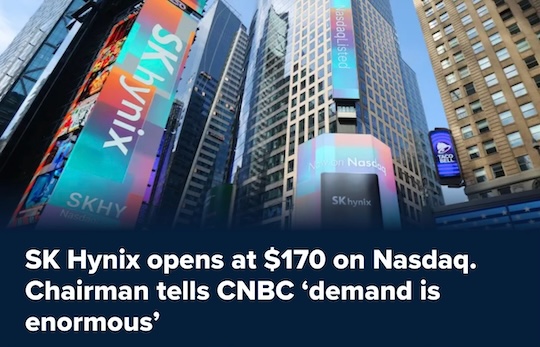 Source: CNBC
The ADR was priced at $149 per share, but demand proved even stronger than expected.
When trading began on Friday, shares opened at around $170, roughly 14% above the offering price, and traded well above the IPO valuation throughout the session.
For a company that many Americans had never heard of just days earlier, it was an extraordinary debut.
Institutional investors understood exactly what they were buying: one of the world's most important suppliers to the AI economy.
Perhaps the most interesting part of the story, however, is that SK Hynix wasn't forced to come to Wall Street because it desperately needed cash.
Quite the opposite.
The company is already generating billions of dollars in annual profits while trading at a valuation that remains modest compared with many of today's AI leaders.
Management chose to list in the U.S. because it recognized an opportunity to broaden its shareholder base, improve liquidity, fund future expansion, and potentially reduce the long-standing "Korea discount" that has historically weighed on many Korean stocks.
In other words, this was a strategic decision made from a position of strength. Not a rescue mission.
Investing in Stories vs. Spreadsheets
One question kept nagging at me as I watched SK Hynix begin trading.
What if Elon Musk had been standing on the Nasdaq stage Friday morning instead of SK Hynix Chairman Chey Tae-won?
Would America have paid more attention?
We'll never know. But it's an interesting thought experiment.
Unlike Elon Musk, who has spent decades becoming one of the world's most recognizable entrepreneurs, Chey Tae-won had never appeared on CNBC before ringing the opening bell.
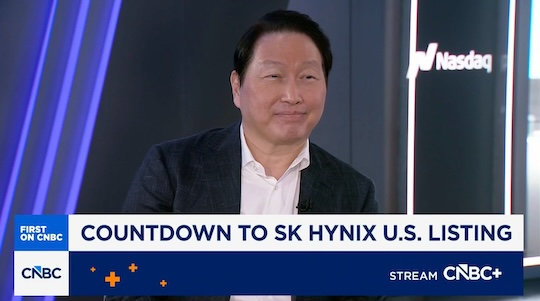 SK Hynix Chairman Chey Tae-won, Live on CNBC. Source: CNBC
Millions of investors know Elon Musk by face.
Very few could have identified Chey Tae-won walking through an airport.
Yet the company he leads sits at the very center of one of the fastest-growing industries in history.
That contrast says less about the two leaders than it does about us.
Human beings naturally connect with stories.
We remember personalities, and we celebrate visionaries. There's nothing wrong with that.
In fact, many of history's greatest companies were built by extraordinary founders capable of inspiring employees, customers, and investors alike.
Steve Jobs became Apple.
Jeff Bezos became Amazon.
Jensen Huang became Nvidia.
Elon Musk became SpaceX.
Visionary leaders transform incredibly complicated businesses into stories everyone can understand. Rockets, electric cars, AI, Mars.
Memory chips don't inspire quite the same emotional reaction.
Yet investing has never been a popularity contest. Wall Street often pays attention to very different things than the rest of us.
While the public naturally gravitates toward visionary founders and bold missions, professional investors spend their days studying earnings, competitive advantages, cash flows, and strategic bottlenecks.
Main Street often invests in stories. Wall Street invests in spreadsheets.
Neither approach is entirely right nor entirely wrong. Great companies often possess both compelling narratives and exceptional financial performance.
SpaceX has unquestionably earned the world's attention through extraordinary technological achievements that have fundamentally reshaped the aerospace industry.
But SK Hynix offers an equally valuable lesson.
Some of history's greatest businesses quietly build extraordinary economics long before they become household names.
Sometimes, the companies making the biggest difference are the ones doing the least talking.
The Bigger Lesson
Every technological revolution creates obvious winners.
It also creates quieter companies supplying the critical infrastructure that makes those headline-grabbing innovations possible.
During the Industrial Revolution, railroads captured the public's imagination. Still, steel producers, coal miners, and equipment manufacturers also built enormous fortunes.
The internet created household names like Google and Amazon. Companies providing fiber-optic networks, semiconductors, and data centers became indispensable.
AI appears to be following the same path.
We've talked before about companies benefiting from AI through electricity generation, data infrastructure, autonomous defense systems, and next-generation communications.
Memory belongs on that list as well. Without it, the AI revolution simply cannot reach its full potential.
That's why Wall Street paid such close attention to SK Hynix's IPO, even as much of the public barely noticed it.
There's nothing wrong with dreaming big.
In fact, some of the greatest investment opportunities in history have been led by visionary entrepreneurs who inspired millions to believe in an extraordinary future.
But every dream eventually collides with reality.
Rockets need fuel. Data centers need electricity. AI needs memory.
Perhaps that's the real lesson from the two biggest IPOs in modern history.
One captured the world's imagination.
The other quietly reminded investors that revolutions aren't built on vision alone. They're built by thousands of companies solving difficult engineering problems that most people never see.
At Truth & Trends, that's exactly the kind of story we're trying to uncover.
Because by the time everyone knows the CEO, understands the technology, and appreciates the opportunity, much of the easy money has often already been made.
The companies we dream about will always deserve our attention.
But the companies that quietly make those dreams possible may deserve even more.
Sign Up Today for Free!
Truth & Trends brings you market insights and trading tips you won't find anywhere else — unless you have your own personal hedge fund manager on speed dial...
Meet Enrique Abeyta, one of Wall Street’s most successful hedge fund managers. With years of experience managing billions of dollars and navigating the highs and lows of the financial markets, Enrique delivers unparalleled market insights straight to your inbox.
In Truth & Trends, Enrique shares his personal take on what’s moving the markets, revealing strategies that made him a star in the world of high finance. Whether it’s uncovering the next big trend or breaking down the hottest stocks and sectors, Enrique’s insights are sharp, actionable, and proven to work in any market condition.
Inside these daily updates, you’ll gain:
- 50 years of combined trading wisdom distilled into actionable insights.
- A behind-the-scenes look at how Wall Street pros spot opportunities and avoid pitfalls.
- Exclusive strategies that Enrique personally uses to deliver exceptional returns — no fluff, just results.
To have Truth & Trends sent directly to your inbox every weekday, just enter your email address below to join this exclusive community of informed traders.
Don’t miss your chance to learn from one of the best in the business.
Sign up now and take your trading game to the next level.
My Tesla Calls Went to Zero... Just as I Planned
Posted July 10, 2026
By Greg Guenthner
Mark Twain Was Right About Your Newsfeed
Posted July 09, 2026
By Enrique Abeyta
Six Months In: My 2026 Report Card
Posted July 06, 2026
By Enrique Abeyta
The S-E-T System for Finding Breakout Stocks
Posted July 03, 2026
By Greg Guenthner

6,019 Reasons to Be a Proud American
Posted July 02, 2026
By Enrique Abeyta
