Posted September 13, 2026

By Nick Riso
The 4 “Insider” Documents Wall Street Reads Before You Do
Call me naive, but it took me a while to understand what market experts meant when they said the news was always late.
Wasn't this breaking information about companies and stocks? Well, sure. That's true.
But when you really get into the data, once you’re fully immersed in this tango with Mr. Market, you come to realize that the biggest, fastest moves in individual stocks usually don't happen because of an earnings report, a CNBC story, or a post on X.
It’s usually because of the numbers. Institutions, hedge funds, price… and paperwork.
For the latter, it’s often government forms that some compliance officer at a hedge fund or a pharmaceutical company was legally required to file, in a format nobody enjoys reading, posted to a government website nobody visits for fun…
And then the stock moves 40% before lunch.
It's just how the plumbing works.
The U.S. government runs what amounts to the largest, most boring, and most consistently profitable information service in the world. And it gives the information away for free.
The catch is that it's buried in acronyms, filed in bulk, and formatted like a tax return.
So the professionals read it, and everyone else finds out from a headline three days later, after the move.
Let’s talk about four of these documents right now.
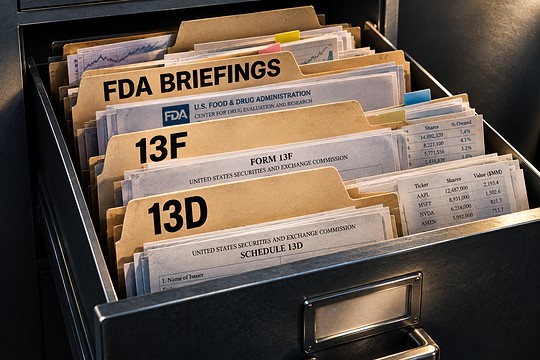
The 13D
If you buy more than 5% of a public company's voting stock and you intend to do something about it — push out the CEO, force a sale, grab board seats — you have to tell the SEC. The form is called a Schedule 13D, and once you file it, it's public.
A billionaire spends months quietly accumulating shares, and of course, nobody knows. Then a legal deadline forces him to stand up in public and announce exactly what he owns and exactly what he plans to do with it.
On Aug. 5, 2024, Elliott Investment Management filed one on Southwest Airlines. The filing disclosed just under 42 million shares, and Southwest rose 3.4% in after-hours trading — after Elliott made clear it wanted new leadership at the airline.
Academic research on hedge fund 13D filings has found an average positive abnormal stock price response of roughly 7% in the targeted company. And that return doesn't fade away afterward.
A Harvard Business School study of activist filings between 1993 and 2006 found 10.3% excess returns over the 18 months beginning one month before the filing.
A 7% pop, on average, from a piece of paper. And a disclosure form no less!
The key here is that the filer had up to ten days to submit it. They, of course, knew before you did. The form exists precisely because Congress decided you deserved to find out at all.
The 13F
Every institutional manager with over $100 million has to disclose their U.S. stock holdings every quarter. The form is a 13F. It publishes 45 days after quarter-end, which means by the time you read it, the information is a month and a half stale.
Doesn't matter though. Stocks still move.
When Berkshire Hathaway revealed a roughly $7 billion position in Chubb — a stake the SEC had let them keep confidential while they were still buying — Chubb shares jumped more than 7% in after-hours trading on the disclosure.
When Berkshire's Q3 filing showed a surprise position in Alphabet, the news moved the stock 3.5% higher after hours — on a purchase that had happened weeks earlier.
Revenue, customers, profits… Nothing actually changed about either company.
The only thing that happened was that a document got published and the rest of the world found out what somebody already owned.
The pattern we’re developing right now is that the stock moved because of the disclosure, not the decision. The decision was old news to the person who made it.
The FDA Briefing Document
This one is the most brutal and the most ignored.
Before the FDA convenes an advisory committee to vote on a drug, the agency posts its reviewers' written analysis publicly, usually about 48 hours ahead of the meeting.
Please, do yourself a favor and never read one. It's a dense PDF written for scientists.
It also routinely detonates biotech stocks before votes are cast.
A couple of months ago, the FDA posted briefing documents ahead of Capricor Therapeutics' advisory committee meeting on its Duchenne muscular dystrophy therapy.
Shares dropped more than 60% that Monday.
Reviewers said Replimune's melanoma trial data isn't interpretable. A lot of us know this story.
The stock crashed nearly 32% in a session, its fifth straight day of losses, down roughly 47% over that stretch.
Now there's the twist here that tells you everything about how this game really works.
Two days after those documents gutted Replimune, the FDA's own advisory committee voted 10–3 that the data were evaluable and clinically meaningful, contradicting the criticism the agency's reviewers had written down two days earlier!
The Pattern
Let’s together take a step back and look at what those first three have in common.
Each one is:
- Public
- Free
- Published on a schedule, or at least on a deadline
- And reliably moves stock prices at the moment of publication, not at the moment the underlying event occurred
That gap between when something becomes true and when it becomes known is where a specific kind of money gets made.
That's how casinos work, too. They’re not hiding the deck (lol). They’re just counting on most people not really paying good enough attention.
Wall Street, as you know by now, looks.
They've built entire desks around these filings — people whose whole job is to open the PDF at 8:00 a.m. and know what it means by 8:04. Retail investors, meanwhile, find out from a push notification that says a stock is "surging on activist interest," which is a polite way of saying you're late.
The Fourth Document
Which brings me to why I'm writing this.
There's a fourth document I wanted to talk about...
It's also published by a government-authorized regulator. It's also completely free. And it's released on a fixed, published schedule that anyone can look up.
And almost no individual investor in America has ever opened it.
JC Parets has. He's spent years building a system around it. And according to that document, the next window opens on September 24th.
And on Thursday, September 17th at 1:00 PM ET, James Altucher is sitting down with JC to walk through exactly what that document is, how to read it, and which stocks it's pointing at right now.
We’ll talk about some market plumbing again soon. I promise.
I have a few ideas about volatility and how to make yourself the “house” with options trading. It’ll be fun. Again, I promise.
Sign Up Today for Free!
Truth & Trends brings you market insights and trading tips you won't find anywhere else — unless you have your own personal hedge fund manager on speed dial...
Meet Enrique Abeyta, one of Wall Street’s most successful hedge fund managers. With years of experience managing billions of dollars and navigating the highs and lows of the financial markets, Enrique delivers unparalleled market insights straight to your inbox.
In Truth & Trends, Enrique shares his personal take on what’s moving the markets, revealing strategies that made him a star in the world of high finance. Whether it’s uncovering the next big trend or breaking down the hottest stocks and sectors, Enrique’s insights are sharp, actionable, and proven to work in any market condition.
Inside these daily updates, you’ll gain:
- 50 years of combined trading wisdom distilled into actionable insights.
- A behind-the-scenes look at how Wall Street pros spot opportunities and avoid pitfalls.
- Exclusive strategies that Enrique personally uses to deliver exceptional returns — no fluff, just results.
To have Truth & Trends sent directly to your inbox every weekday, just enter your email address below to join this exclusive community of informed traders.
Don’t miss your chance to learn from one of the best in the business.
Sign up now and take your trading game to the next level.

The Melt-Up Is Coming. But First...
Posted September 11, 2026
By Greg Guenthner

The COVID Economy Never Ended
Posted September 10, 2026
By Enrique Abeyta

6 Horsemen of the OpenAI-pocalypse
Posted September 07, 2026
By Enrique Abeyta

The Man Taking Apple to $10 Trillion
Posted September 04, 2026
By Chris Cimorelli
Welcome to Wall Street’s Most Dangerous Month
Posted September 03, 2026
By Enrique Abeyta