
Posted April 27, 2026

By Enrique Abeyta
Strait Talk: The 15-Day Countdown
Iran holds the keys to the global oil market.
When Iran shuts down the Strait of Hormuz, oil spikes, inflation surges, and markets spiral.
That’s the narrative you’ve heard nonstop for the past two months. But that’s not the whole story.
Let’s start with what we know.
The Strait of Hormuz handles roughly 20 million barrels of oil per day, about a quarter of global seaborne petroleum trade.
If flows through that channel are meaningfully disrupted, prices can spike violently.
JPMorgan Chase noted that a prolonged disruption could push oil toward $150 per barrel, forcing demand destruction across the global economy.
That’s the core fear driving the narrative right now.
But the truth is that Iran’s greatest leverage could also be its greatest vulnerability.
The Risk That Could Break Iran’s Oil Leverage
Below is a scenario model built by JPMorgan Chase that shows how oil flows through the Strait of Hormuz could behave after a conflict.
It shows oil flows collapsing almost immediately afterward.
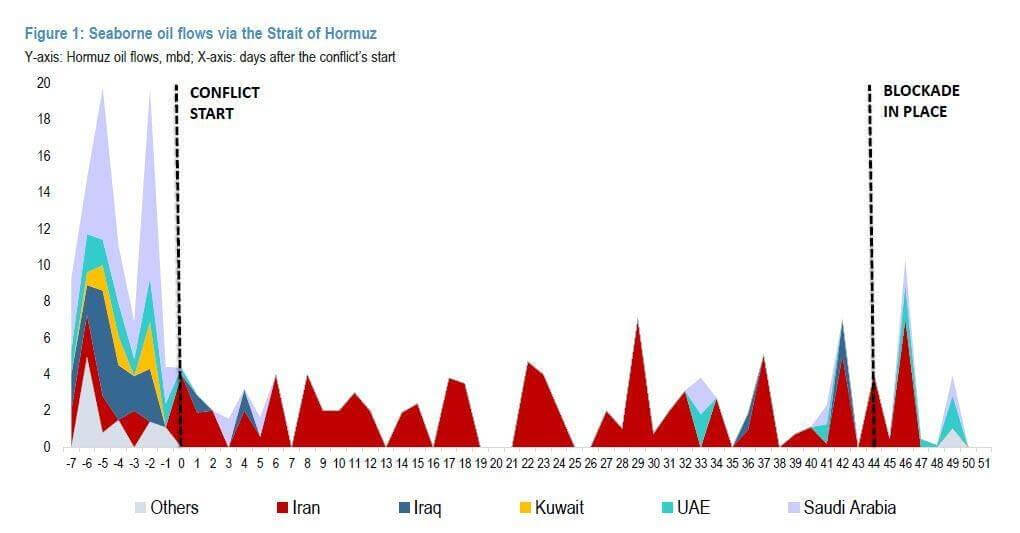
In the days leading up to the conflict, seaborne oil volumes drop sharply across nearly every major exporter in the region.
Iran, Iraq, Kuwait, the UAE, and even Saudi Arabia all see disruptions ripple through the system at once.
This is a sudden break in the system, not something the market can calmly price in over time.
And it fuels the narrative that Iran holds all the leverage. But here’s the part most investors miss.
A system that breaks this quickly isn’t built to stay broken for long.
If the first chart shows how fast flows can break, this next one shows something even more important — what happens next.
The chart below, compiled using data from the EIA, Kpler, and JPMorgan Chase, tracks Iran’s oil production versus its exports over time.
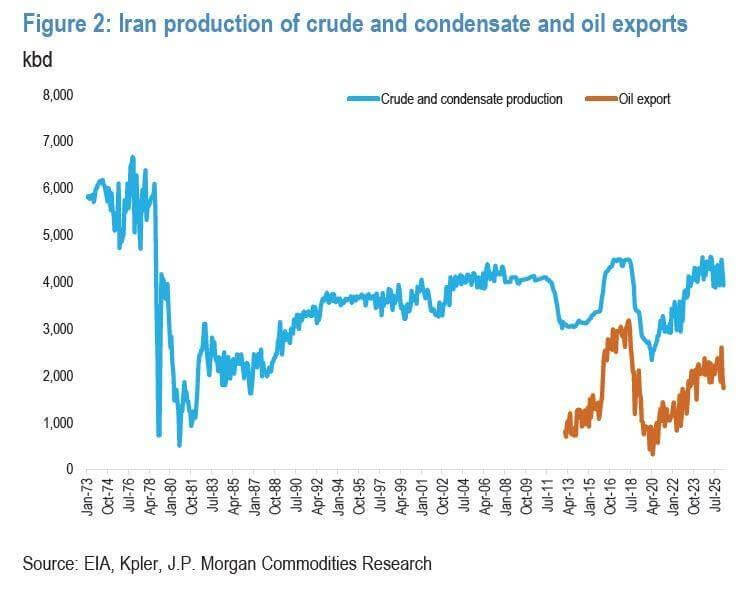
You can see that oil exports and production follow each other closely. Exports drop first, and then production drops next.
That’s the dynamic the market is now focused on.
According to JPMorgan analysis, Iran has a limited window (about 15 days) before export disruptions begin forcing real constraints on its system.
Storage fills, logistics bottleneck, and production eventually has to respond. These are the “shut-ins”.
And in a country with aging oil fields, shutting in wells can damage reservoir pressure, reduce long-term output, and create lasting economic consequences.
That’s when the narrative flips. When Iran is disrupting global supply, it’s disrupting itself.
Iran’s position looks strong at first. It can disrupt supply and move global markets with a single threat.
But the longer a disruption lasts, the more the pressure shifts inward.
Iran’s economy is deeply dependent on oil revenue. It needs production, exports, and flow.
And if blocking the Strait of Hormuz leads to its own production being shut in, then what looks like leverage becomes a liability.
Markets are already starting to reject the idea that Iran holds all the cards.
If Iran truly had unlimited leverage, we’d see sustained panic and breakdowns across equities and credit.
But right now, we’re seeing something else entirely.
The Market Isn’t Buying the Panic Narrative
Markets are forward-looking. And right now, they appear to anticipate that any disruptions will likely be temporary.
Not because the situation isn’t serious, but because it’s self-limiting.
The longer flows are disrupted, the greater the risk to Iran’s own production system. That creates a built-in incentive to avoid prolonged shutdowns.
Meanwhile, the global system has buffers.
Strategic reserves can be tapped. Alternative routes and pipelines can partially offset losses. Other producers can increase output at the margin.
None of these is a perfect solution, but they don't have to be. They just have to bridge the gap.
And in markets, bridging the gap is often enough.
That said, this isn’t a risk-free scenario. Even a short-term spike in oil prices can ripple through the economy.
Gas prices rise. Transportation costs increase. Businesses adjust pricing. Consumers feel it almost immediately.
That feeds into inflation. And inflation feeds directly into central bank policy.
If oil spikes hard enough, even temporarily, it complicates the path forward for rate cuts and economic growth. It tightens financial conditions in a way that policymakers can’t ignore.
But again, duration is everything.
A sharp, short spike may be disruptive, but it’s manageable. A prolonged surge is something else entirely.
And based on current market behavior, the base case remains the former.
Moments like this create clarity around what matters most.
Energy remains front and center. Not just producers, but the broader ecosystem, oil services, infrastructure, logistics.
If supply chains are disrupted or damaged, they will need to be rebuilt. That creates demand that persists long after the headlines fade.
Defense and security are another clear theme. Conflicts reshape priorities, and spending in these areas tends to rise sustainably, not in temporary bursts.
But the biggest takeaway may be more structural.
We are continuing to see a shift toward real assets, things that power economies, not just financial systems.
Energy, metals, infrastructure, and strategic resources are becoming increasingly central to how markets are valued and how capital is allocated.
This is a long-term repositioning, not a short-term trade.
Back to the Big Picture
There’s a tendency in markets to focus on the immediate shock.
But the real story often emerges afterward, when constraints become clear and incentives start to drive behavior.
That’s where we are now.
The narrative says Iran controls the outcome. The data suggests Iran is operating on a clock.
And the market? It’s already starting to price in what that clock means.
Not a prolonged shutdown or a permanent crisis, but a situation where pressure builds quickly enough to force resolution.
Because in the global oil system, there’s one rule that overrides everything else: It has to keep moving.
Sign Up Today for Free!
Truth & Trends brings you market insights and trading tips you won't find anywhere else — unless you have your own personal hedge fund manager on speed dial...
Meet Enrique Abeyta, one of Wall Street’s most successful hedge fund managers. With years of experience managing billions of dollars and navigating the highs and lows of the financial markets, Enrique delivers unparalleled market insights straight to your inbox.
In Truth & Trends, Enrique shares his personal take on what’s moving the markets, revealing strategies that made him a star in the world of high finance. Whether it’s uncovering the next big trend or breaking down the hottest stocks and sectors, Enrique’s insights are sharp, actionable, and proven to work in any market condition.
Inside these daily updates, you’ll gain:
- 50 years of combined trading wisdom distilled into actionable insights.
- A behind-the-scenes look at how Wall Street pros spot opportunities and avoid pitfalls.
- Exclusive strategies that Enrique personally uses to deliver exceptional returns — no fluff, just results.
To have Truth & Trends sent directly to your inbox every weekday, just enter your email address below to join this exclusive community of informed traders.
Don’t miss your chance to learn from one of the best in the business.
Sign up now and take your trading game to the next level.

"Trump Accounts" Coming Soon (DO NOT Wait)
Posted April 23, 2026
By Enrique Abeyta

Word of the Day: "Oikophobia"
Posted April 20, 2026
By Enrique Abeyta

Remedy for the Tax Day Hangover
Posted April 16, 2026
By Enrique Abeyta

The Night America Burned the Blockade
Posted April 13, 2026
By Enrique Abeyta
Quick 5-Minute Masterclass on Finding Breakout Stocks
Posted April 10, 2026
By Greg Guenthner
