Posted November 05, 2026

By Enrique Abeyta
OpenAI Is the Next Bear Stearns
Friday, March 14, 2008.
It's a chilly morning in Midtown Manhattan.
Yellow taxis crowd Madison Avenue as thousands of New Yorkers hurry to work. Outside the towering headquarters of Bear Stearns, everything appears normal.
But inside, one of Wall Street's most powerful investment banks is fighting for its life.
Founded in 1923, Bear Stearns has survived the Great Depression, World War II, and countless market crashes.
It's America's fifth-largest investment bank, with nearly $400 billion in assets and a reputation for being virtually untouchable.
Just 14 months earlier, its shares traded above $170.
Now, executives are watching a nightmare unfold as lenders withdraw their money and trading partners lose faith.
The firm is running out of cash, and the Federal Reserve has been forced to arrange emergency funding.
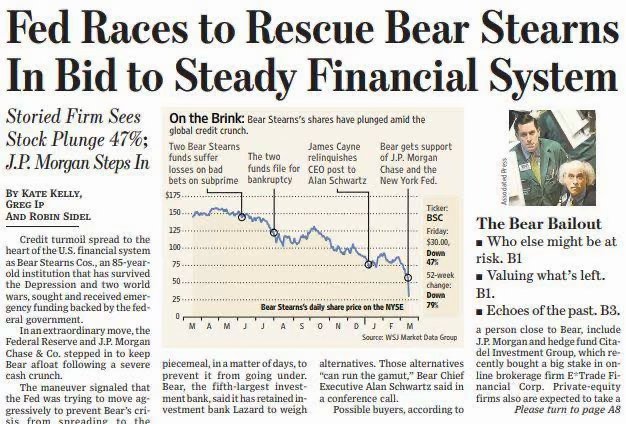 Source: Wall Street Journal Front Page, March 14, 2008
But it's too late.
On Sunday, March 16, JPMorgan Chase agrees to buy Bear Stearns for an initial offer of just $2 a share.
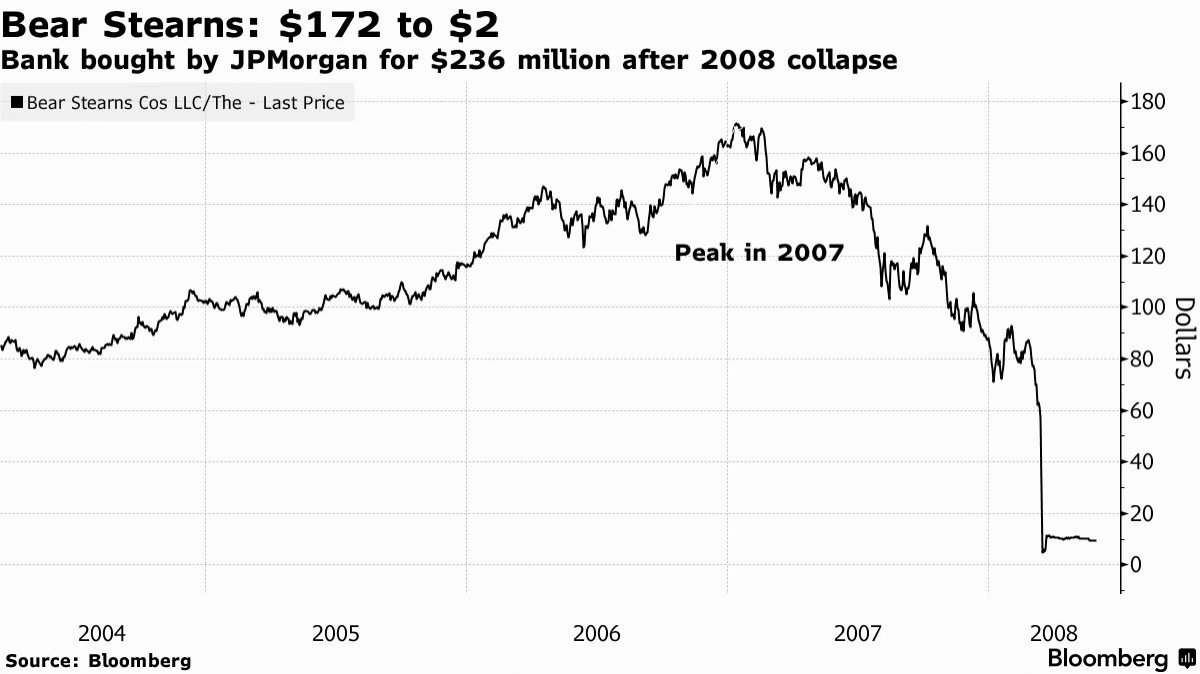 Source: Bloomberg
A Wall Street giant has been brought to its knees, and the news sends shock waves through financial markets worldwide.
Yet the worst is still to come.
Six months later, Lehman Brothers will collapse, pushing an already severe housing and credit crisis into what becomes known as the Global Financial Crisis, one of history's worst financial disasters.
Banks will fail, credit markets will freeze, and trillions of dollars in wealth will vanish. By March 2009, the S&P 500 will have lost nearly 58% from its October 2007 peak.
Why am I taking you back to that fateful weekend?
Because I believe we're approaching another Bear Stearns moment.
Only this time, the company at the center of the storm won't be a Wall Street investment bank.
It will be OpenAI.
In my AI House of Cards series, I've warned about the massive debts, risky deals, and staggering costs supporting the AI boom.
Now, those risks are beginning to show up in OpenAI's own finances.
Today, I'll explain why OpenAI's IPO could fail, why the warning signs are already flashing, and what that could mean for your money.
The Warning Signs Were There
Bear Stearns didn't collapse without warning.
In 2007, two of its hedge funds, loaded with risky mortgage investments, ran into serious trouble. Both eventually failed, revealing weaknesses that extended far beyond the firm itself.
Despite these warning signs, few expected one of Wall Street's most respected firms to disappear.
By March 2008, lenders and trading partners were pulling back, threatening the short-term borrowing that kept Bear Stearns afloat.
As confidence evaporated, so did its cash reserves. Within days, the firm collapsed.
The lesson wasn't simply that Bear Stearns had made bad investments.
It’s that even the mightiest companies can collapse when they need more cash than investors will provide.
And that brings us to OpenAI.
OpenAI's $278 Billion Problem
Think about how the world views OpenAI today.
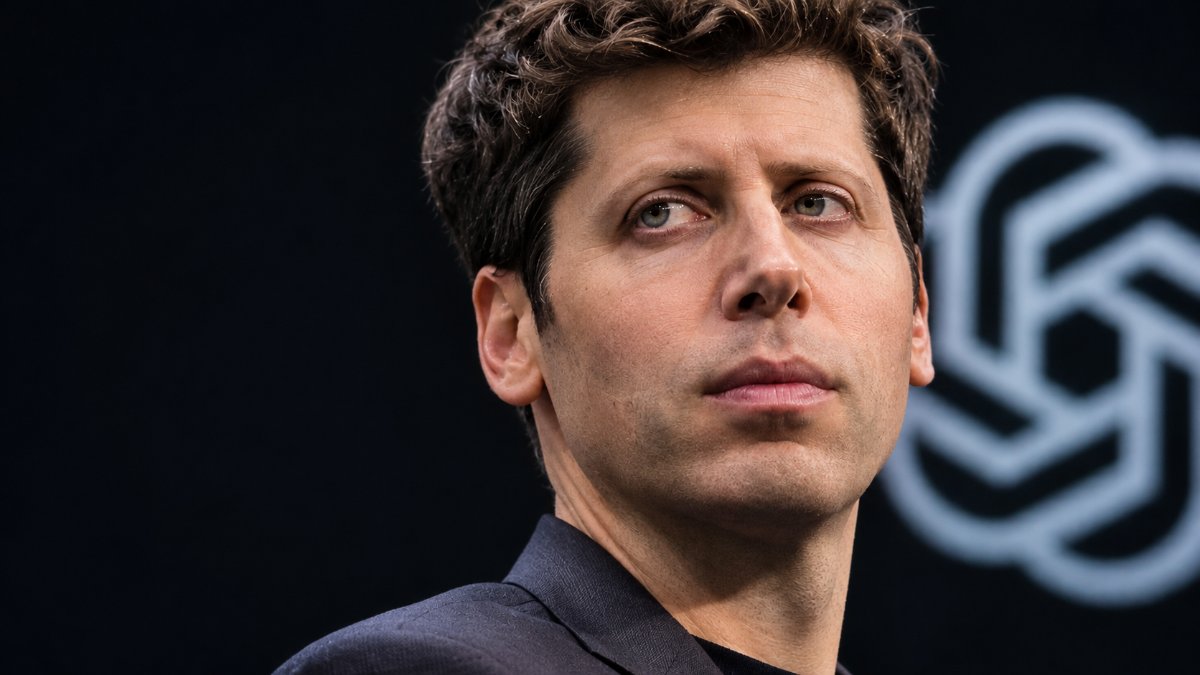
Led by Sam Altman, the company behind ChatGPT has become one of the hottest names in technology.
Its products are used worldwide, and investors have been willing to value it at more than $1 trillion.
For many, OpenAI represents the future of artificial intelligence.
But being an industry leader doesn't guarantee a sound business model.
In September, the Financial Times reported that OpenAI expects to generate negative free cash flow totaling $278 billion between 2026 and 2030.
In plain English, it expects to spend $278 billion more cash than it brings in over those five years.
That's an astonishing sum, especially considering OpenAI forecasts annual revenue could climb from $36 billion in 2026 to $350 billion by 2030.
The company also reportedly expects to spend roughly $856 billion on computing power and infrastructure through the end of the decade.
Even if OpenAI meets its ambitious sales forecasts, it expects to burn through enormous amounts of cash that must come from outside investors.
OpenAI has already raised huge sums, including a reported $122 billion earlier this year. Yet the same September report says it could exhaust that funding by 2028.
And OpenAI isn't the only company seeking billions.
Anthropic needs enormous funding for its own AI plans.
Meanwhile, Microsoft, Amazon, Google, Meta, Oracle, and countless data center developers are spending heavily on infrastructure.
Many rely on investors and lenders to finance those projects.
But there's only so much capital available, and competition for it is growing.
That's a serious problem for a company that may need hundreds of billions more before its business can support itself.
OpenAI’s Funding Squeeze
Now we're seeing evidence that the money is getting harder to find.
Last Friday, October 30, the Financial Times reported that OpenAI had slashed its latest fundraising target from $30 billion to $20 billion.
That's a one-third reduction.
The company also reportedly lowered its desired valuation from $1.4 trillion to $1.25 trillion, a $150 billion cut.
But here's the most troubling part.
OpenAI had set October 30 as the deadline for investor commitments. Yet some major backers reportedly reduced their planned investments.
According to The Wall Street Journal, OpenAI had secured only about $11 billion in initial commitments and was preparing to seek additional funding from wealthy individuals and family offices.
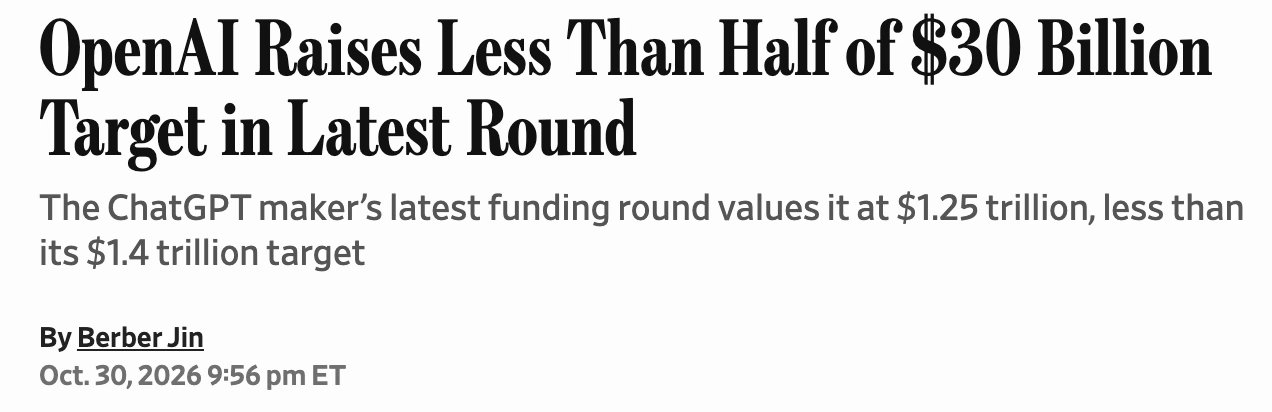 Source: Wall Street Journal
One of the hottest companies on the planet has so far fallen well short of its original fundraising goal and is reportedly looking beyond traditional institutional investors to fill the gap.
These aren't hypothetical warning signs. They're appearing right now.
OpenAI still has powerful backers and access to enormous sums of money.
But if it's already struggling to raise $30 billion, what happens when it needs the next $30 billion?
Or the next $50 billion?
There's another complication.
OpenAI's biggest rival, Anthropic, is preparing to go public. Its IPO filings have exposed huge losses and spending commitments, while recent changes have invited further scrutiny.
I believe Anthropic will make it through its IPO, perhaps barely. But its disclosures could make investors even more wary of OpenAI's finances.
I'll return to Anthropic's IPO saga in a future issue.
For now, OpenAI faces a more urgent question.
What happens if the public markets refuse to give it the money it needs?
What If OpenAI's IPO Fails?
OpenAI is reportedly pursuing a stock market listing in 2027.
I believe that IPO could fail, not because ChatGPT suddenly stops working or demand for AI disappears, but because building the technology has become so expensive.
OpenAI's future depends on billions of dollars in computing infrastructure.
If investors refuse to finance those plans, the company may have to delay projects, renegotiate contracts, or accept funding on far worse terms.
In a more severe scenario, OpenAI could need an emergency rescue from a major backer. If funding dries up while substantial obligations remain, bankruptcy could become a real risk.
And the damage wouldn't stop at OpenAI.
Its spending plans support an enormous network of chipmakers, cloud providers, data center developers, and lenders.
Nvidia sells the chips powering the AI boom, while Oracle and other infrastructure firms are investing heavily in computing capacity.
Lenders are financing projects based on expectations of continued AI demand.
Now imagine OpenAI announces that it must sharply reduce its spending plans.
Suppliers expecting years of rapid growth could face weaker demand. Data center projects might be delayed, while lenders begin questioning whether the cash flows supporting their loans will materialize.
Investors could then start cutting the prices they're willing to pay for AI stocks.
I've warned about these risks throughout my AI House of Cards series. But OpenAI could become the event that brings them into focus.
The technology itself may keep advancing. The problem is that investors could discover they've paid enormous prices for growth that cannot be financed forever.
The Next Bear Stearns Moment
In March 2008, Bear Stearns' collapse stunned Wall Street.
Six months later, Lehman Brothers collapsed, and the financial crisis entered its most destructive phase.
Bear Stearns didn't cause every disaster that followed. It revealed how fragile the financial system had become.
I believe OpenAI could play the same role in the AI bubble.
That's why I'm paying such close attention to its next fundraising round and plans to go public.
For investors, the danger isn't limited to OpenAI itself.
It's the possibility that a funding crisis at one company could trigger a much broader selloff in AI stocks, including those held in millions of retirement accounts.
I'll continue tracking these developments and alert you as new risks emerge. Because if my Bear Stearns comparison proves correct, the time to prepare is before the rest of the market recognizes the danger.
Bear Stearns was the warning shot before the worst of the Global Financial Crisis.
I believe OpenAI could play the same role in the coming AI crash.
And the clock is already ticking.
Sign Up Today for Free!
Truth & Trends brings you market insights and trading tips you won't find anywhere else — unless you have your own personal hedge fund manager on speed dial...
Meet Enrique Abeyta, one of Wall Street’s most successful hedge fund managers. With years of experience managing billions of dollars and navigating the highs and lows of the financial markets, Enrique delivers unparalleled market insights straight to your inbox.
In Truth & Trends, Enrique shares his personal take on what’s moving the markets, revealing strategies that made him a star in the world of high finance. Whether it’s uncovering the next big trend or breaking down the hottest stocks and sectors, Enrique’s insights are sharp, actionable, and proven to work in any market condition.
Inside these daily updates, you’ll gain:
- 50 years of combined trading wisdom distilled into actionable insights.
- A behind-the-scenes look at how Wall Street pros spot opportunities and avoid pitfalls.
- Exclusive strategies that Enrique personally uses to deliver exceptional returns — no fluff, just results.
To have Truth & Trends sent directly to your inbox every weekday, just enter your email address below to join this exclusive community of informed traders.
Don’t miss your chance to learn from one of the best in the business.
Sign up now and take your trading game to the next level.
IBM: The "Lose-Lose" AI Trade
Posted November 04, 2026
By Zach Scheidt

The Big Split Behind This Year's Market
Posted November 03, 2026
By JC Parets
The Election Is Coming! Sell Everything! (Just Kidding)
Posted November 02, 2026
By Enrique Abeyta
You Gotta Be Quicker Than That!
Posted October 30, 2026
By Greg Guenthner
NVIDIA: The Biggest Stock Massacre in History
Posted October 29, 2026
By Enrique Abeyta