Posted October 05, 2026

By Enrique Abeyta
Micron Could Get Cut in Half. Here’s Why.
Micron Technology (MU) absolutely crushed earnings last week.
The company reported $54.2 billion in quarterly revenue — a 379% jump from last year — thanks to the AI-driven memory boom.
Management expects the good times to continue, forecasting roughly $61.5 billion in revenue next quarter, well ahead of Wall Street estimates.
It was one of the most remarkable earnings reports I’ve seen from a major American company.
So what I’m about to say might sound crazy. But here it goes…
I believe Micron stock could lose half its value (or more) sometime over the next 6 to 24 months.
Let me be clear. I’m not predicting that the stock is due for an immediate crash.
In fact, I wouldn’t be surprised to see MU continue climbing over the next six months if excitement around AI picks back up.
I even like the company long-term. I'm bullish on Micron looking three, five, and even 10 years out.
It’s the period in between that concerns me.
After three decades of watching Wall Street cycles, Micron is showing me some very familiar warning signs.
And what happens to Micron could eventually happen to other AI leaders like Nvidia or Broadcom.
What’s Behind the Micron Hype in the First Place
First, I want to make something clear. Micron is an incredible company.
It’s one of the world’s leading memory manufacturers, and AI has completely transformed its business.
Micron’s revenue for fiscal 2026 reached $133.2 billion, up from $37.4 billion the previous year, while adjusted earnings jumped from $8.29 to $75.52 per share.
And the stock has followed. Shares are up over 450% in the past year.
Wall Street now increasingly believes AI has permanently changed Micron and broken the cycle that has defined the company for decades.
That’s where I disagree.
Memory has always been cyclical.
When chips become scarce, prices rise, and manufacturers make enormous profits.
Those profits encourage companies to build more capacity. Eventually supply catches up, prices fall, margins shrink, and profits follow.
You can see it in Micron’s earnings.
Adjusted EPS reached $11.95 in fiscal 2018, then fell to just $2.83 by 2020. Earnings surged again to $8.35 in 2022, only for Micron to lose $4.45 per share the following year.
The same boom-and-bust pattern shows up in Micron’s margins.
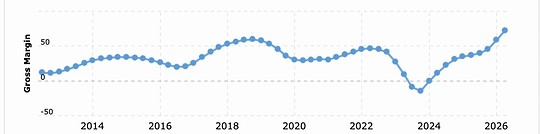
Micron Gross Margin, 2012–June 2026
 Source: Macrotrends
Look closely, and you can see the same cycles.
Gross margins climbed to around 50% in 2018, fell below 30% by 2020, recovered above 40% in 2022, then plunged below zero in 2023.
Each major swing roughly tracks the earnings cycle we just described.
And the latest upswing has been extraordinary.
The chart only runs through June, but Micron’s gross margin has since reached an astounding 87% in the quarter it just reported, while adjusted EPS hit $33.42.
AI has produced a historic memory shortage, with demand overwhelming supply and allowing Micron to raise prices and earn extraordinary profits.
But shortages have a funny way of creating their own cure. High prices encourage more supply, and right now everyone is spending.
Will We Really Build All This?
You may have seen this chart circulating lately. It shows some of the biggest infrastructure buildouts of the past 200 years and the spending as a percentage of GDP.
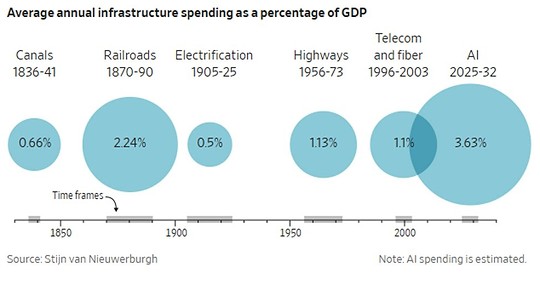
The estimate for AI is staggering. But there’s an important caveat buried at the bottom of the chart…
AI spending is estimated.
These are projections of what could be built, not money already spent.
My prediction is that we don’t see even half of it.
We’re already getting reminders that announcing a data center and actually building one are very different things.
Oracle recently invoked a force majeure provision tied to potential power delays at its massive Project Jupiter development for OpenAI in New Mexico.
The project hasn’t been canceled, but it shows how real-world constraints can interfere with even the biggest AI projects.
Then there’s growing public and political resistance.

More than 100 proposed data-center moratoriums are now being considered around the country as concerns grow over electricity, water, land, and infrastructure costs.
That doesn’t mean America stops building data centers.
It means investors shouldn’t confuse planned spending with guaranteed spending.
The same caution applies to Micron.
Bulls point to $32 billion of customer commitments and roughly $150 billion of “remaining performance obligations” as evidence that demand is locked in for years.
Those numbers matter, but they aren’t $150 billion sitting in Micron’s bank account.
Revenue still has to be earned as products are delivered and contractual obligations are satisfied.
Meanwhile, Micron and its competitors are spending billions to add capacity to meet both those commitments and anticipated future demand.
However, if new supply arrives just as some of today's projected AI demand gets delayed, reduced, or disappears, the equation changes quickly.
And here’s the key: Micron’s business doesn’t need to collapse.
An 87% gross margin could become 80%, then perhaps 75%.
Pricing power weakens, and Wall Street cuts future earnings estimates.
Investors suddenly remember that memory is cyclical, and a stock valued for extraordinary conditions begins discounting ordinary ones.
That’s how cycles turn. Which brings me back to Micron’s earnings report last week.
The Market Is Trying to Tell Us Something
Micron didn’t merely beat expectations. It demolished them.
Revenue more than quadrupled, margins reached record territory, and management's next-quarter revenue forecast came in roughly $4.5 billion above Wall Street expectations.
Yet the stock initially fell after the report.
Shares recovered Thursday and gained roughly 3%. But compare that with June, when another blockbuster Micron report sent shares soaring about 17% in a single session.
Then came Friday. A soft jobs report sent stocks higher, with the Nasdaq jumping more than 1% to a new record and Nvidia gaining nearly 2%.
But Micron traded lower.
That gets my attention because after 30 years on Wall Street, I’ve learned to notice when a stock stops reacting to good news the way you’d expect.
Early in a cycle, good news can send a stock soaring. Later, it takes great news to produce the same reaction. Eventually, even great news isn’t enough.
Sometimes the stock is already looking toward what comes next.
That brings me to the real reason I'm writing this today. Micron may be an early warning for the much larger AI trade.
Nvidia alone is worth around $6 trillion.
Cut that stock in half and roughly $3 trillion of market value disappears!
Now imagine Micron, Broadcom, and several other AI leaders falling 40% or 50% as investors reset their expectations.
We’re talking about trillions of dollars disappearing from the stock market.
We’ve seen what happens when a technology boom reverses. The Nasdaq lost nearly 80% during the dot-com bust.
I’m not predicting anything remotely that severe. We don’t need anything close to it to do enormous damage.
In 2022, for example, the Nasdaq fell roughly a third.
With today’s market so dependent on a small group of enormous technology companies, I could easily envision another 30% or greater decline if the AI trade unwinds sharply.
And because these companies dominate major indexes, the damage wouldn’t stop with investors who own AI stocks. It will hit index funds and retirement accounts across America.
Watch What Stocks Do
None of this means AI is going away or Micron stops selling memory chips. And it certainly doesn’t mean MU can’t climb higher first.
That’s what makes this moment so interesting. Micron’s numbers still look fantastic, demand remains strong, and its margins are extraordinary.
But after three decades of watching markets, I’ve learned that stocks often begin telling you the story before earnings do.
That's why I'll be watching how Micron, Nvidia, Broadcom, and the other AI leaders react to their results over the coming months and reporting back to you here.
If spectacular earnings keep producing increasingly disappointing stock reactions, I'll take that as another warning that the cycle is turning.
Remember, great companies don’t have to fail for their stocks to get cut in half. Expectations simply must change.
Micron is a great American company, and I believe it will remain one for decades.
But that doesn’t mean I want to own it at every price and at every point in the cycle.
If I personally owned MU today, I’d rather take profits while the numbers still look this good than wait around to find out what happens when they don’t.
Sign Up Today for Free!
Truth & Trends brings you market insights and trading tips you won't find anywhere else — unless you have your own personal hedge fund manager on speed dial...
Meet Enrique Abeyta, one of Wall Street’s most successful hedge fund managers. With years of experience managing billions of dollars and navigating the highs and lows of the financial markets, Enrique delivers unparalleled market insights straight to your inbox.
In Truth & Trends, Enrique shares his personal take on what’s moving the markets, revealing strategies that made him a star in the world of high finance. Whether it’s uncovering the next big trend or breaking down the hottest stocks and sectors, Enrique’s insights are sharp, actionable, and proven to work in any market condition.
Inside these daily updates, you’ll gain:
- 50 years of combined trading wisdom distilled into actionable insights.
- A behind-the-scenes look at how Wall Street pros spot opportunities and avoid pitfalls.
- Exclusive strategies that Enrique personally uses to deliver exceptional returns — no fluff, just results.
To have Truth & Trends sent directly to your inbox every weekday, just enter your email address below to join this exclusive community of informed traders.
Don’t miss your chance to learn from one of the best in the business.
Sign up now and take your trading game to the next level.

The AI “Mega-Theme” Nobody’s Talking About Yet
Posted October 02, 2026
By Greg Guenthner

Here Lies the AI Trade (2022-2026)
Posted October 01, 2026
By Enrique Abeyta

The End of AI's "Honeymoon Phase"
Posted September 28, 2026
By Enrique Abeyta
Bitcoin’s Breakout Is Just the Beginning
Posted September 25, 2026
By Greg Guenthner

$100 Oil and “the New Normal”
Posted September 24, 2026
By Enrique Abeyta