Posted June 08, 2026

By Enrique Abeyta
Friday's Violent Sell-Off (It Changes Nothing)
They say the bigger they are, the harder they fall. That's certainly how it feels in the stock market lately.
After hitting a fresh all-time high earlier in the week, the Nasdaq fell a staggering 1,121 points last Friday.
That makes it the index’s largest single-day point decline on record. But let’s put that stat into perspective…
The index’s second-worst point drop on record was on April 3, 2025, or down 5.97%. Third place is March 16, 2020, when the index was down 12.32%.
Last Friday? Down 4.18%.
Now, I don’t want to minimize that kind of drop.
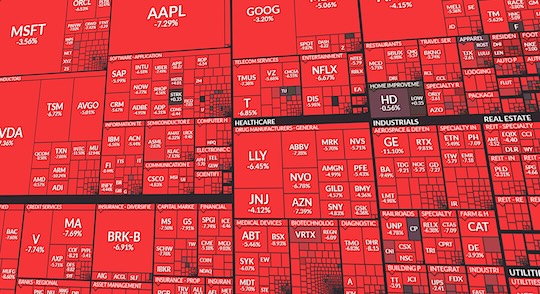
In a single session, $1.8 trillion in market value disappeared from S&P 500 companies alone. Real money, real portfolios, and real pain. I'm not here to tell you otherwise.
But it’s worth putting these pullbacks into perspective, especially in today’s market when every other headline is about the AI bubble bursting.
That’s what I want to talk to you about today.
This Is What a Healthy Bull Market Looks Like
Before last Friday’s drop, the stock market had been on a historic winning streak. So a pullback was to be expected at some point.
Here is a chart of the Nasdaq, along with my favorite technical indicator, the relative strength index (RSI).
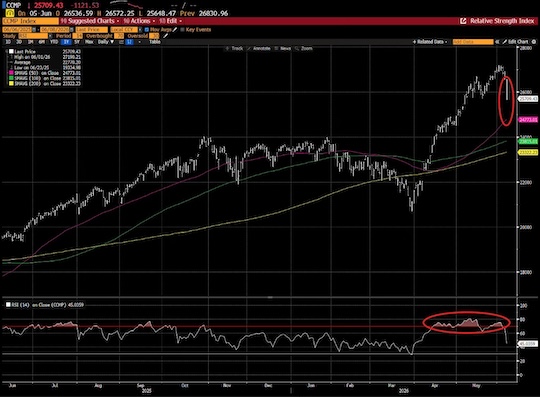
The bottom red circle shows how the RSI of the overall index had been trading above the “overbought” level (above 70) for most of the last few weeks.
This is a sign that the market will need to take a break, at least in the short term.
The top red circle shows how far extended the index was from its 50-day moving average (the violet line). That is a good measure of how far the index needs to go to correct.
Before Friday’s sell-off, the Nasdaq was more than 10% above its 50-day moving average. This is in the 95%+ percentile of extension from that moving average over the last 30 years.
Half that distance was closed on Friday, but I think the rest of that distance will be closed in the next few days or weeks.
Here’s what you need to keep in mind…
The market going down like this is actually healthy for the overall bull trend. Retracing to the rising moving averages lets the market reset and curbs some of the most rampant speculation.
Nobody can say whether this correction will be mild and very short or something a bit more extended (testing the 100-day and 200-day moving averages).
But what we do know is that this bull market is very, very strong.
Over the past several weeks, I have seen dozens of rare technical signals that all point to the same thing…
The stock market will be HIGHER in one year.
There have only been a few times in my 30 years as a professional investor when I have had this degree of confidence that the stock market will be higher in a year.
The last time was after the COVID shutdowns, when I (correctly) predicted that we would see one of the greatest periods of GDP growth since World War II.
The confidence I have now is different in terms of the details, but it’s similar in terms of probability.
Obviously, there are no guarantees in the stock market. But the evidence is overwhelming.
The Dot-Com Comparison Strikes Again
The last time many of these technical signals appeared was back in the late 1990s. That makes sense, since the period has obvious similarities to the current stock market.
While AI bulls might protest, the buildup for the AI revolution is nearly identical to the buildup for the internet.
Here’s a chart of the Nasdaq from 1995 to 2002.
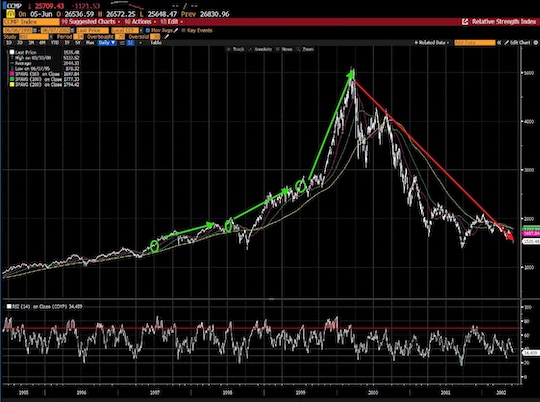
On the chart, I have put green circles around June 1997,1998 and 1999.
Current bears, like my friend Michael Burry, believe that the stock market looks like March 2000, right before the huge collapse (the red line).
I understand his fundamental views, and a few of the technical indicators agree with him.
The problem with the thesis is that those technical indicators also occurred earlier during the late 1990s run.
The other technical indicators that say we have further to run also outnumber the March 2000 ones by a ratio of five-to-one.
I 100% agree with Michael on his fundamental thesis, but I disagree on the timing.
Take a look at the chart above, and you will see what happened after the periods I circled.
From June 1997 to June 1998, the Nasdaq was up +29%. The following year, it was up another +41%. And by June 2000, it was up another +61%.
That last one actually includes part of the eventual sell-off. If you look from June 1999 to the peak in March 2000, the Nasdaq was up +106% — in just nine months!
So, do I think we are in 1997, 1998, or 1999? Honestly, I don’t know.
What I do know is that any of those three had pretty good outcomes for stock investors a year later, even with corrections along the way.
How to Know When the Party’s Over
What’s more, I also know what started every major bear market of the last 50 years. (I define “major” as -25% or greater decline and longer than a year.)
The answer is the Fed raising rates.
Here’s the chart of the Fed Funds target rate over the course of my career.
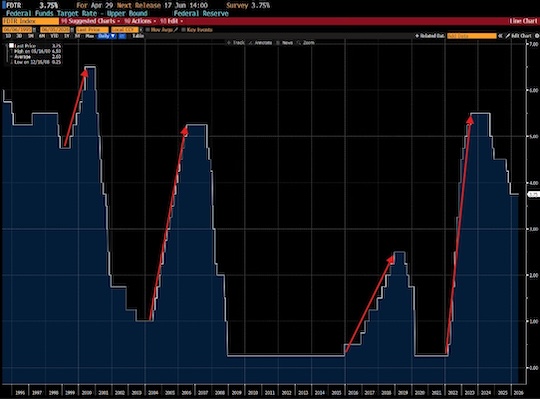
The red arrows show the periods where the Fed was raising rates. Note that each of these was in front of one of these major stock market pullbacks.
Interestingly, though, they are not coincident with the bear markets. The market doesn’t fall until after the Fed has been raising rates for a while.
They started raising rates in June 1999, and the market didn’t crack until March 2000.
Pre-dating the Global Financial Crisis, they started raising rates in June 2004, and the stock market didn’t begin its real decline until October 2007.
Pre-COVID, they started raising rates in December 2016, and we didn’t see a collapse until four years later.
The only period where they were more closely aligned was in 2022, when the first rate hike was in February of that year and the stock market had begun to sell off in January.
Maybe this time will be like 2022. But the more important point is that the Fed is not raising rates yet.
Given recent economic strength and inflation, perhaps they will in 2026. I don’t think so, given the political setup, but it is a possibility.
Regardless, I think the weight of the evidence points to the bull market continuing for the next year.
Later this week, I will share a collection of the signals I referenced today.
In the meantime, I hope you took some profits on the recent rally. Stay disciplined and be prepared to pick up some winners that have corrected.
Most importantly, make sure you are positioned for the bull market in front of us — it has room to run!
Sign Up Today for Free!
Truth & Trends brings you market insights and trading tips you won't find anywhere else — unless you have your own personal hedge fund manager on speed dial...
Meet Enrique Abeyta, one of Wall Street’s most successful hedge fund managers. With years of experience managing billions of dollars and navigating the highs and lows of the financial markets, Enrique delivers unparalleled market insights straight to your inbox.
In Truth & Trends, Enrique shares his personal take on what’s moving the markets, revealing strategies that made him a star in the world of high finance. Whether it’s uncovering the next big trend or breaking down the hottest stocks and sectors, Enrique’s insights are sharp, actionable, and proven to work in any market condition.
Inside these daily updates, you’ll gain:
- 50 years of combined trading wisdom distilled into actionable insights.
- A behind-the-scenes look at how Wall Street pros spot opportunities and avoid pitfalls.
- Exclusive strategies that Enrique personally uses to deliver exceptional returns — no fluff, just results.
To have Truth & Trends sent directly to your inbox every weekday, just enter your email address below to join this exclusive community of informed traders.
Don’t miss your chance to learn from one of the best in the business.
Sign up now and take your trading game to the next level.

Bitcoin Is Boring
Posted June 05, 2026
By Greg Guenthner

What History's Biggest IPOs Say About SpaceX
Posted June 04, 2026
By Enrique Abeyta

Someone Knows Something About Tesla
Posted June 03, 2026
By Nick Riso

For Whom the IPO Bell Tolls (SpaceX)
Posted June 01, 2026
By Nick Riso

Reports of Software's Death Are Greatly Exaggerated
Posted May 29, 2026
By Greg Guenthner
