
Posted August 13, 2026

By Enrique Abeyta
33,575 Cracks Beneath the Bull Market
You've probably heard that the AI bubble is going to burst at any moment. Maybe it will eventually.
But the early warning signs that this bull market is running into trouble may not show in the places most people expect.
Instead, it could be in an area of the financial markets that often gets overlooked…
Private capital.
I'm talking about the enormous world of private equity and private credit that’s exploded outside of traditional public markets and banks.
Now, you might hear “private credit” and think of the last financial crisis or a house of cards waiting to fall.
So I want to be clear up front. I'm not predicting another financial crisis.
But some of what I see today is familiar enough that I think you should be paying attention.
The Early Signs of Financial Stress
I saw an article in The New York Times this week with a remarkable statistic that caught my attention.
As of June 30, private equity firms were sitting on 33,575 unsold companies, according to PitchBook. That's up from 32,451 at the end of last year and just 15,923 a decade ago.
What's remarkable is the environment in which this is happening.
Public stocks remain strong.
The first half of 2026 was the second-busiest period for IPOs in more than a decade. Major acquisitions are getting done.
Yet private equity firms are struggling to find buyers willing to pay the prices they want for thousands of companies.
The performance gap is equally striking.
From July 2022 through March 2026, U.S. private equity generated annualized returns of just 6.4%, according to MSCI, compared with 15.2% for the S&P 500 and 19.3% for the Nasdaq.
Higher interest rates are a big reason why. Private equity firms spent years buying companies using cheap borrowed money.
Today's buyers have to finance those acquisitions at much higher rates, making yesterday's valuations difficult to justify.
So instead of selling, many private equity owners are waiting.
They are refinancing debt, extending maturities and hoping that lower interest rates, stronger markets or improved business conditions eventually allow them to exit at better prices.
None of this means those companies are failing.
But when tens of thousands of private businesses are stuck in portfolios while owners and lenders push their exit dates and debt maturities further into the future, it's worth watching.
To understand why, let’s go back about 20 years.
Lessons From the Housing Bubble
Most investors remember the 2008 Global Financial Crisis as a housing crash.
While that's true, it misses an important part of what transformed falling home prices into a global financial catastrophe.
You see, housing was the bubble, but securitization is what helped spread the risk.
For years, lenders issued increasingly risky mortgages that were bundled into mortgage-backed securities, or MBS.
Those securities could then be sliced, repackaged and combined into collateralized debt obligations, or CDOs.
The financial system took risk that originated with individual mortgages and distributed it across banks, hedge funds, investment firms and investors around the world.
Leverage magnified the consequences. And the first warnings didn't come from stocks.
By the first half of 2007, subprime delinquencies were climbing, and mortgage securities were deteriorating.
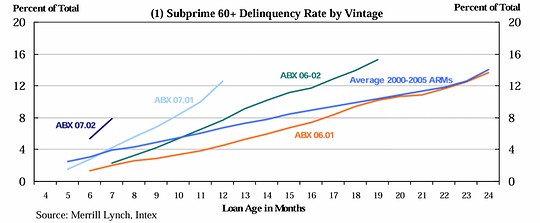 Source: Federal Reserve August 2007 FOMC Presentation
Two Bear Stearns hedge funds heavily exposed to mortgage debt collapsed that summer. Yet stocks kept rising.
The S&P 500 didn't reach its pre-crisis peak until Oct. 9, 2007, months after credit markets had begun flashing warning signs.
That's the history I keep thinking about today.
If AI and the zero-interest-rate era helped inflate today's asset boom, could private capital be a mechanism through which some of those excesses are exposed and spread?
We can’t know for sure, but there are enough similarities that I want to watch this closely.
Private Credit's $1.4 Trillion Experiment
Private credit has exploded since the Global Financial Crisis, partly because tighter regulation pushed traditional banks away from some forms of risky corporate lending.
Nonbank lenders stepped in.
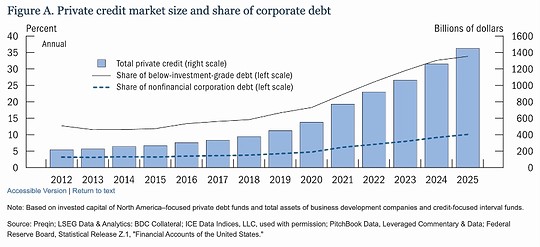 Source: Federal Reserve
According to the Federal Reserve, private credit now represents roughly $1.4 trillion of U.S. corporate debt.
Unlike publicly traded bonds, much of this lending occurs in private markets where prices, valuations and borrower health can be considerably less transparent.
And we're beginning to see signs of stress.
One of the most interesting is the growing use of payment-in-kind, or PIK, interest. The concept is actually quite simple.
Imagine that I owe you $100 but can't comfortably make my interest payment. Instead of requiring cash today, you allow me to add the interest to the loan balance.
Don't have the cash to pay me today?
Fine. I'll add the interest to what you owe me tomorrow.
That can buy a healthy company valuable time. But when its use begins rising among highly leveraged borrowers, it's something worth watching.
The same is true of the amend-and-extend transactions we're seeing.
Rather than force a borrower to refinance, sell or recognize a loss, lenders can change the terms and push the maturity farther into the future.
As evidence that this may be occurring at a larger level than the market imagines, in February, S&P Global Ratings reported that conventional defaults among the private companies it tracks were just 1.13% at the end of 2025.
But include “selective defaults,” which can involve things like converting cash interest to PIK or extending maturities, and the default rate rises to 4.5%.
Again, none of this means a crisis is underway.
But extend the loan. Amend the terms. Capitalize the interest. Delay the sale. Eventually, somebody has to determine what these assets are actually worth.
This is where the story circles back to the AI bubble everyone is talking about.
The AI Connection
Software became one of private equity's favorite targets during the era of near-zero interest rates.
Many of those acquisitions were made around 2021, when software valuations were near historic highs.
Then the AI boom arrived.
Suddenly, investors had to consider whether AI could disrupt the future economics of some of the businesses private equity firms had purchased at premium valuations.
The Times specifically identifies software as one of the most troubled areas of today's private-equity pipeline.
Rather than sell some of those companies and potentially recognize painful losses, owners are waiting.
AI doesn't have to be what ultimately exposes problems in private capital. Rates could stay higher. The economy could weaken. Credit conditions could deteriorate. Valuations could reset.
Or nothing severe may happen at all.
The point is that while everyone is watching AI stocks for signs that the bubble is bursting, stress may be accumulating somewhere else entirely.
There are important differences between today and 2008, so I want to state this clearly.
Private credit is NOT subprime mortgage debt.
Banks are better capitalized. Mortgage underwriting is dramatically different.
And many private-credit funds are financed with long-term investor capital rather than the fragile short-term funding structures that helped turn mortgage losses into a systemic crisis.
What’s more, private capital's lack of daily liquidity can actually be a strength.
A fund that doesn't have to sell assets during a temporary panic may be able to wait for conditions to improve.
That's why I'm not predicting another 2008. But the similarities still deserve your attention.
Years of cheap money encouraged leverage and elevated valuations. Credit migrated into less transparent parts of the financial system.
Some borrowers are extending maturities, restructuring obligations and capitalizing interest rather than resolving their debts. Private-equity owners are delaying exits because buyers won't meet their prices.
Meanwhile, public stocks remain strong.
Watch the Credit Markets Closely
There’s one more lesson from history that I don't want to overlook.
We may not know exactly what ultimately causes a bubble to burst. But we have a pretty good idea when the risks become greatest…
When the Fed tightens financial conditions.
We saw it when the Fed raised rates beginning in 1999, helping bring the excesses of the dot-com era to an end.
We saw it again when rates climbed in 2004 and continued higher through 2006, tightening the credit conditions that eventually exposed the weaknesses in housing and subprime mortgages.
And we saw another version beginning in 2022, when the fastest Fed tightening cycle in decades helped puncture speculative excesses across technology, crypto and other risk assets.
It’s crucial that we remember these two key points.
- Easy money helps inflate bubbles.
- Tighter money has a way of revealing what was hiding inside them.
That's particularly important today because many of the private-equity deals and private-credit loans we're discussing were created when money was extraordinarily cheap.
Higher rates didn't create those risks. They changed the economics and began exposing them.
The lesson of 2007 isn't that every crack in the credit market becomes 2008. It's that investors shouldn't wait for the stock market to tell them something is wrong.
Now, let me be clear, I'm not telling you to sell your stocks or abandon this bull market.
But to identify risks that could threaten it, we need to look beyond Nvidia, AI valuations, and the major market averages.
Right now, one of the places I'm watching most closely is private capital.
I'll be monitoring private-credit defaults, PIK usage, refinancing activity, private-equity exits and signs that stress is beginning to migrate into banks or public credit markets.
Maybe these signal fires burn themselves out. I hope they do.
But if they start spreading, I'll stay on top of them and make sure you understand what they're telling us.
Sign Up Today for Free!
Truth & Trends brings you market insights and trading tips you won't find anywhere else — unless you have your own personal hedge fund manager on speed dial...
Meet Enrique Abeyta, one of Wall Street’s most successful hedge fund managers. With years of experience managing billions of dollars and navigating the highs and lows of the financial markets, Enrique delivers unparalleled market insights straight to your inbox.
In Truth & Trends, Enrique shares his personal take on what’s moving the markets, revealing strategies that made him a star in the world of high finance. Whether it’s uncovering the next big trend or breaking down the hottest stocks and sectors, Enrique’s insights are sharp, actionable, and proven to work in any market condition.
Inside these daily updates, you’ll gain:
- 50 years of combined trading wisdom distilled into actionable insights.
- A behind-the-scenes look at how Wall Street pros spot opportunities and avoid pitfalls.
- Exclusive strategies that Enrique personally uses to deliver exceptional returns — no fluff, just results.
To have Truth & Trends sent directly to your inbox every weekday, just enter your email address below to join this exclusive community of informed traders.
Don’t miss your chance to learn from one of the best in the business.
Sign up now and take your trading game to the next level.

The $900M Humanoid Robot IPO
Posted August 10, 2026
By Enrique Abeyta

Choose Sanity: Signal Over Noise
Posted August 07, 2026
By Greg Guenthner
Signs of '99: Is This the End?
Posted August 03, 2026
By Enrique Abeyta
The Last Face You See
Posted July 31, 2026
By Greg Guenthner

Micron: Don't Tip the Raft!
Posted July 30, 2026
By Enrique Abeyta
